

UPSC Mapping
| Prelims | Economy & Technology |
|---|---|
| Mains | GS Paper 3 (Economic Development & Technology) |
Quick Facts
| Launch Year | 2025 |
|---|---|
| Tenure | 6 years |
| Focus | Passive electronic components |
What is the Electronics Components Scheme?
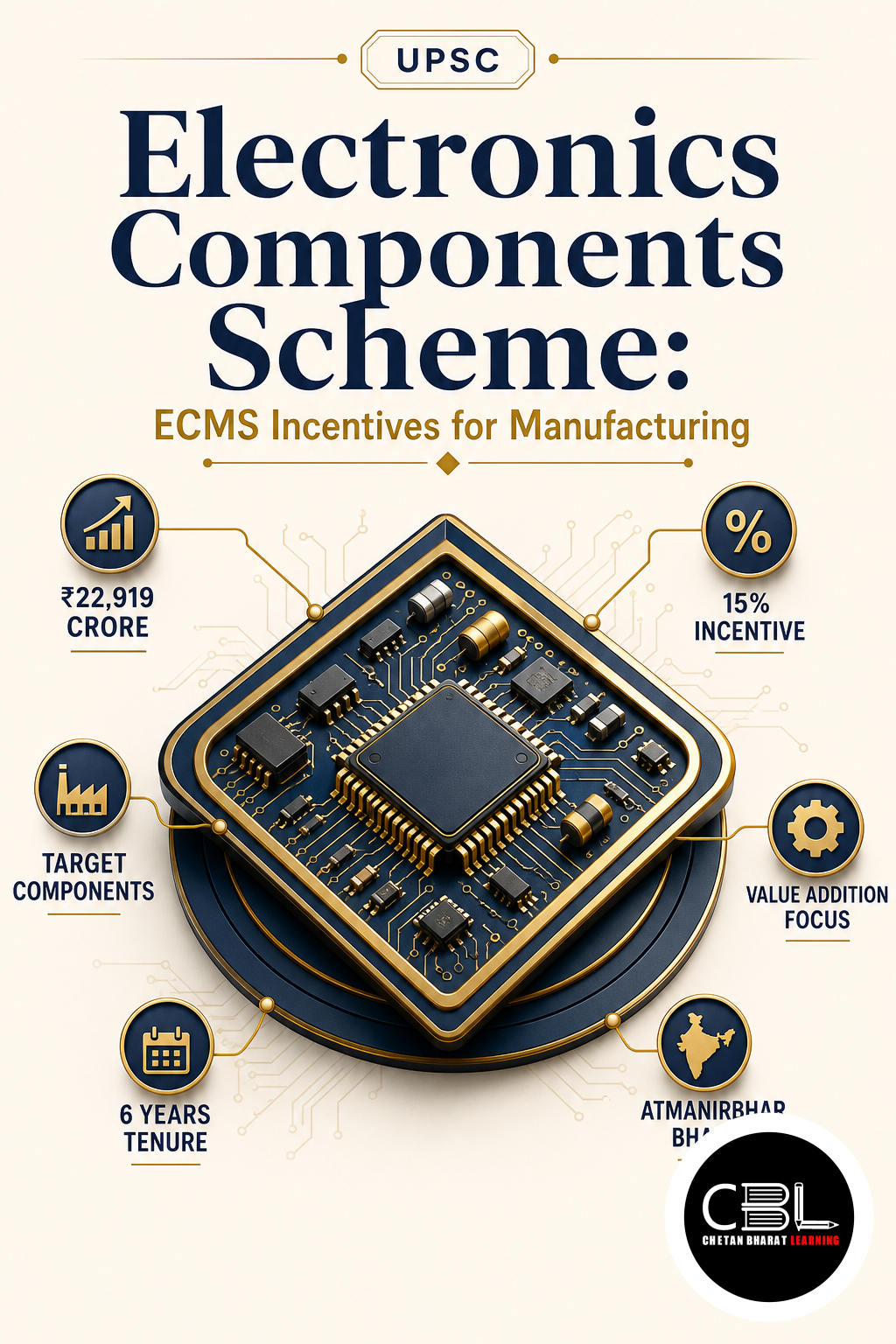
The Electronics Components Scheme (ECMS) is a government initiative launched in 2025 by the Ministry of Electronics and Information Technology (MeitY) to build a domestic component manufacturing ecosystem. The scheme offers three incentive structures: turnover-linked incentive (based on revenue), capex-linked incentive (for investments in plants and machinery), and a hybrid incentive model combining both.
Employment generation is mandatory for all applicants, including both component manufacturers and capital equipment producers. The scheme has a six-year tenure with a one-year gestation period for the Turnover Linked Incentive, while the Capex Incentive is available for a five-year period. It focuses particularly on passive electronic components such as resistors, capacitors, speakers, microphones, special ceramics, relays, switches, and connectors.
Why is the Electronics Components Scheme in News?
The Electronics Components Scheme is in the news because MeitY approved 31 more applications, indicating growing interest from the industry. The scheme aims to reduce import dependence and build a self-reliant electronics ecosystem, complementing the India Semiconductor Mission (ISM) which focuses on active components.
The scheme’s focus on passive components is significant, as these are essential for a wide range of electronics—from consumer devices to industrial equipment. For more details, refer to the PIB release.
Key Features of the Electronics Components Scheme
- Three Incentive Models: Turnover-linked, capex-linked, and hybrid models to attract diverse investments.
- Mandatory Employment Generation: All applicants must create jobs as a condition for incentives.
- Focus on Passive Components: Targets resistors, capacitors, speakers, microphones, relays, switches, and connectors.
- Complementary to ISM: Passive components under ECMS; active components under India Semiconductor Mission.
- Global Value Chain Integration: Aims to integrate India’s electronics industry with GVCs.
Challenges in the Electronics Components Scheme
- Global Competition: Competing with established manufacturing hubs like China and Taiwan.
- Technology Gaps: India lacks advanced manufacturing capabilities in some passive component segments.
- Raw Material Availability: Access to high-quality raw materials at competitive prices.
- Infrastructure: Reliable power, logistics, and industrial infrastructure are essential.
- Skilled Workforce: Need for trained engineers and technicians in specialised manufacturing.
Way Forward for the Electronics Components Scheme
To maximise the Electronics Components Scheme‘s impact, the government should streamline approval processes and ensure timely disbursement of incentives. Establishing common facility centres and testing laboratories can reduce costs for MSMEs.
Collaborations with global leaders for technology transfer and joint ventures can accelerate capability building. Strengthening the domestic supply chain for raw materials and promoting R&D in advanced materials are essential. Regular monitoring and performance reviews will ensure the scheme achieves its objectives.
Prelims Practice Corner
- Which ministry launched the Electronics Components Scheme?
(a) Ministry of Heavy Industries (b) Ministry of Electronics and IT (c) Ministry of Commerce (d) Ministry of Finance
Answer: (b) Ministry of Electronics and IT - What is the tenure of the Electronics Components Scheme?
(a) 3 years (b) 5 years (c) 6 years (d) 10 years
Answer: (c) 6 years - Which type of components does ECMS focus on?
(a) Active components (b) Passive components (c) Semiconductors (d) Microprocessors
Answer: (b) Passive components - What is mandatory for all applicants under the scheme?
(a) Export obligation (b) Employment generation (c) Technology transfer (d) Foreign collaboration
Answer: (b) Employment generation - Which mission complements ECMS for active components?
(a) Digital India Mission (b) India Semiconductor Mission (c) Make in India (d) Skill India
Answer: (b) India Semiconductor Mission
Mains Practice Questions
Q1. Discuss the significance of the Electronics Components Manufacturing Scheme in India’s journey towards self-reliance in electronics. (250 words, 15 marks)
Intro: Introduce ECMS and its objectives.
Body: Discuss the incentive structures, focus on passive components, complementarity with ISM; analyse challenges like global competition, technology gaps, infrastructure; suggest measures such as technology transfer, R&D, supply chain strengthening.
Conclusion: Emphasise the need for a comprehensive electronics ecosystem.
Q2. What is the difference between active and passive electronic components, and why does this distinction matter for policy? (150 words, 10 marks)
Intro: Define active and passive components.
Body: Active components (semiconductors, transistors) require power and amplify signals; passive components (resistors, capacitors) do not require power and shape signals. The distinction matters because India uses different policy instruments—ISM for active, ECMS for passive.
Conclusion: Conclude that targeted policies are needed for each segment.
FAQs on Electronics Components Scheme
What is the Electronics Components Scheme?
It is a government initiative to build a domestic component manufacturing ecosystem for passive electronic components.
What are the incentive structures under ECMS?
Turnover-linked, capex-linked, and hybrid incentive models.
How does ECMS complement the India Semiconductor Mission?
ECMS focuses on passive components, while ISM focuses on active components and semiconductors.
Related Current Affairs
Preparing for UPSC, PCS or HCS?
Talk to a mentor at Chetan Bharat Learning, Chandigarh. Free guidance on choosing the right exam and building a study plan.
Chat on WhatsAppCall 97793 53345UPSC / IAS / PCS coaching in Chandigarh · Trusted by aspirants across Punjab & Haryana
Leave a Reply
You must be logged in to post a comment.