

UPSC Mapping
- Prelims: Polity & Judiciary
- Mains: GS Paper 2 (Polity)
| Constitutional Articles | 124(2) & 217 |
|---|---|
| High Court Collegium | Chief Justice + 2 senior judges |
| Recent Appointments | 30 judges across 4 High Courts |
What is HC Judges Appointment?
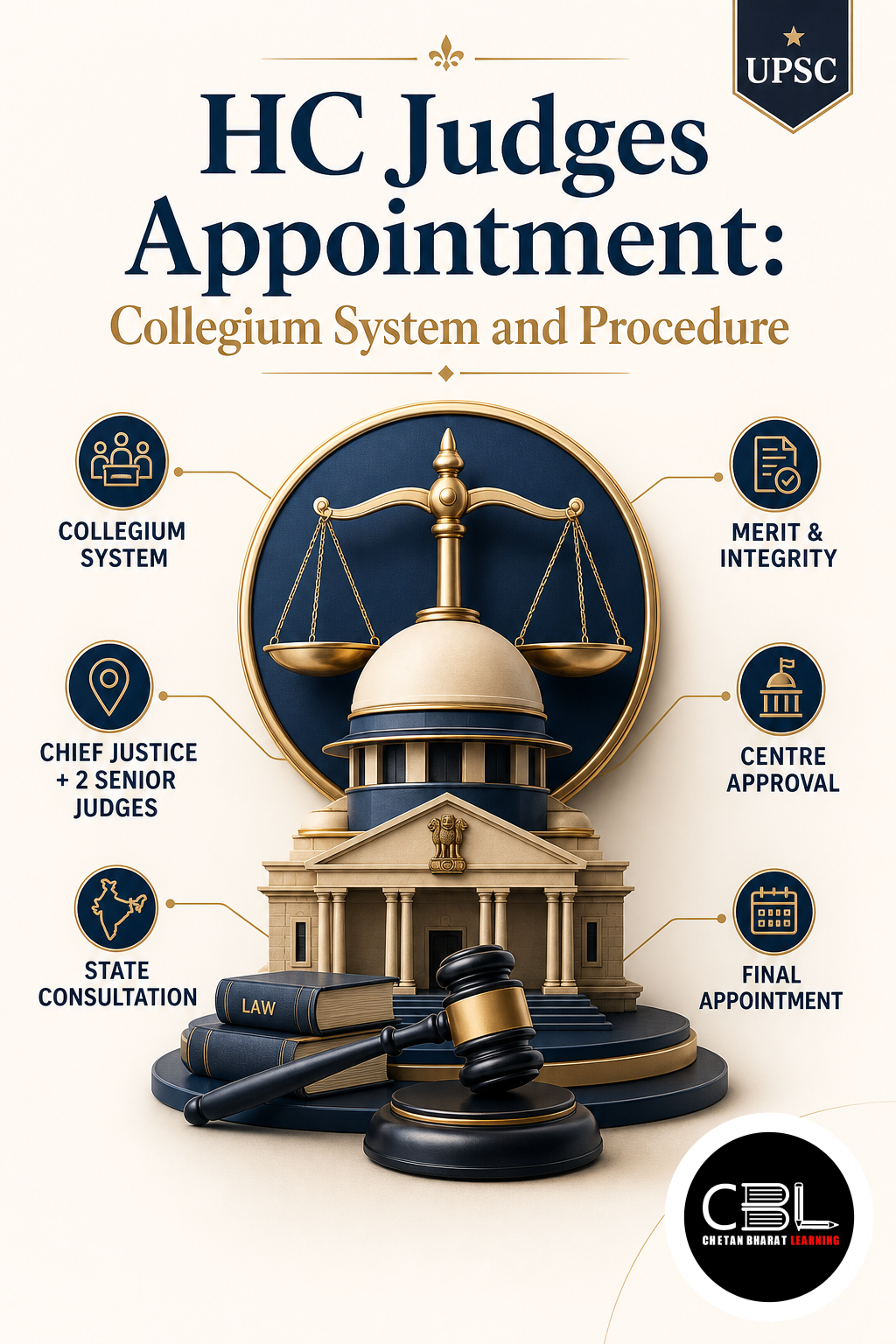
HC Judges Appointment refers to the process of appointing judges to High Courts under the Constitution of India, governed by Articles 124(2) for the Supreme Court and Article 217 for High Courts. The system relies on the collegium mechanism, where the High Court Collegium comprises the Chief Justice of the High Court and two senior-most judges.
The proposal for appointment is initiated by the Chief Justice of the concerned High Court. The names recommended by the HC Collegium are sent, along with the views of the government, to the Supreme Court Collegium for advice. Ultimately, the government appoints only those judges recommended by the Collegium, ensuring judicial independence.
Why is HC Judges Appointment in News?
The HC Judges Appointment has been in the news because the Centre recently notified the appointment of 30 judges for the High Courts of Madras, Calcutta, Madhya Pradesh, and Karnataka. Madras High Court received the largest share, reflecting efforts to reduce longstanding vacancies in the higher judiciary.
This follows the Supreme Court Collegium’s recommendations and the government’s acceptance, highlighting the ongoing cooperation between the executive and judiciary in the appointment process. For official updates, refer to the PIB release.
Key Features of HC Judges Appointment
- Collegium System: The HC Collegium (Chief Justice + two senior judges) recommends names, and the Supreme Court Collegium (CJI + four senior-most SC judges) provides final advice.
- Constitutional Basis: Articles 124(2) and 217 provide the framework, ensuring the appointment is made by the President after consultation with the Chief Justice.
- Initiation: For High Court judges, the proposal is initiated by the Chief Justice of the concerned HC, not by the government.
- Government Role: The government can send its views but is bound to appoint those recommended by the Collegium; it cannot veto or alter the recommendations.
- Transfer and Elevation: The same collegium system also deals with transfers of HC judges and elevations to the Supreme Court.
Challenges Associated with HC Judges Appointment
- Delay in Appointments: There is often a significant time lag between recommendations and final notifications, leading to a high number of vacancies.
- Lack of Transparency: The collegium system operates without a formal, transparent selection criteria, leading to criticism over opacity.
- Executive-Judiciary Tussle: Occasional disagreements between the government and the collegium over suitability of candidates cause delays.
- Representation Issues: Underrepresentation of women, minorities, and marginalised communities remains a concern in HC appointments.
- Objection Handling: The government’s power to raise objections on national security grounds has been used selectively, sometimes delaying the process.
Way Forward for HC Judges Appointment
To improve the HC Judges Appointment process, the government and judiciary should work towards a more transparent and time-bound mechanism. Introducing a structured evaluation system, including public interviews or a judicial commission, could enhance credibility while preserving judicial primacy.
Setting clear timelines for each stage—from HC Collegium recommendation to final notification—can reduce vacancies. Additionally, proactive outreach to ensure diverse representation and faster handling of objections can strengthen the system. A collaborative approach, as recommended by various parliamentary committees, is essential. For detailed guidelines, refer to the Ministry of Law and Justice.
Prelims Practice Corner
Q1. Under which Article of the Constitution are High Court judges appointed?
(a) Article 124 (b) Article 217 (c) Article 233 (d) Article 235
Answer: (b) Article 217 deals with the appointment of High Court judges.
Q2. Who constitutes the High Court Collegium?
(a) Chief Justice of India and 4 senior SC judges (b) Chief Justice of the HC and 2 senior-most HC judges (c) President and Governor (d) Prime Minister and Law Minister
Answer: (b) The HC Collegium comprises the Chief Justice of the High Court and two senior-most judges.
Q3. Who initiates the proposal for appointing a High Court judge?
(a) President of India (b) Governor of the State (c) Chief Justice of the High Court (d) Union Law Minister
Answer: (c) The proposal is initiated by the Chief Justice of the concerned High Court.
Q4. The recent notification appointed 30 judges for how many High Courts?
(a) 2 (b) 3 (c) 4 (d) 5
Answer: (c) The appointments were for Madras, Calcutta, Madhya Pradesh, and Karnataka High Courts.
Q5. Which High Court received the largest share of the recent appointments?
(a) Calcutta (b) Madras (c) Madhya Pradesh (d) Karnataka
Answer: (b) Madras High Court received the largest share.
Mains Practice Questions
Q1. Critically examine the role of the collegium system in the appointment of High Court judges. Discuss its strengths and weaknesses in the context of judicial independence and transparency. (250 words, 15 marks)
Intro: Introduce the collegium system and its constitutional basis.
Body: Discuss strengths: judicial primacy, insulation from executive influence. Weaknesses: lack of transparency, delays, underrepresentation.
Conclusion: Suggest reforms like a National Judicial Appointments Commission (NJAC) with safeguards.
Q2. What are the constitutional provisions governing the appointment of High Court judges? How does the process ensure the independence of the judiciary? (150 words, 10 marks)
Intro: Mention Articles 124(2) and 217.
Body: Explain the collegium system, initiation by HC CJ, and the binding nature of recommendations. Highlight that the executive’s role is limited to consultation, ensuring judicial independence.
Conclusion: Conclude that while the system ensures independence, it requires reforms for greater accountability.
FAQs on HC Judges Appointment
What is the collegium system for HC judges?
It is a system where the Chief Justice of the High Court and two senior-most judges recommend appointments, and the Supreme Court Collegium provides final advice; the government is bound to appoint those recommended.
Who initiates the proposal for HC judge appointment?
The proposal is initiated by the Chief Justice of the concerned High Court, not by the government.
What is the government’s role in HC judge appointment?
The government can provide its views on the recommendations but is constitutionally bound to appoint the judges recommended by the collegium.
Related Current Affairs
Preparing for UPSC, PCS or HCS?
Talk to a mentor at Chetan Bharat Learning, Chandigarh. Free guidance on choosing the right exam and building a study plan.
Chat on WhatsAppCall 97793 53345UPSC / IAS / PCS coaching in Chandigarh · Trusted by aspirants across Punjab & Haryana
Leave a Reply
You must be logged in to post a comment.