

UPSC Mapping
| Prelims | Economy & Infrastructure |
|---|---|
| Mains | GS Paper 3 (Economic Development) |
| Nodal Ministry | Ministry of Heavy Industries |
|---|---|
| Subsidy (2W) | ₹2,500/kWh or ₹5,000 max |
| Charging Grant | ₹2,000 crore |
| Valid Till | 31 March 2028 |
What is the PM E-Drive Scheme?
The PM E-Drive Scheme (PM Electric Drive Revolution in Innovative Vehicle Enhancement) is India’s flagship incentive programme for electric vehicles, administered by the Ministry of Heavy Industries. It replaced the FAME-II scheme to accelerate EV adoption and expand public charging infrastructure across the country.
The scheme provides subsidies only for EVs equipped with advanced batteries like lithium-ion, explicitly excluding lead-acid models. It covers electric two-wheelers, three-wheelers, ambulances, trucks, and public transport buses, but notably excludes the four-wheeled passenger car segment. Individual buyers with Aadhaar-linked mobile numbers can claim a subsidy for one EV per category, either personal or commercial.
Why is the PM E-Drive Scheme in News?
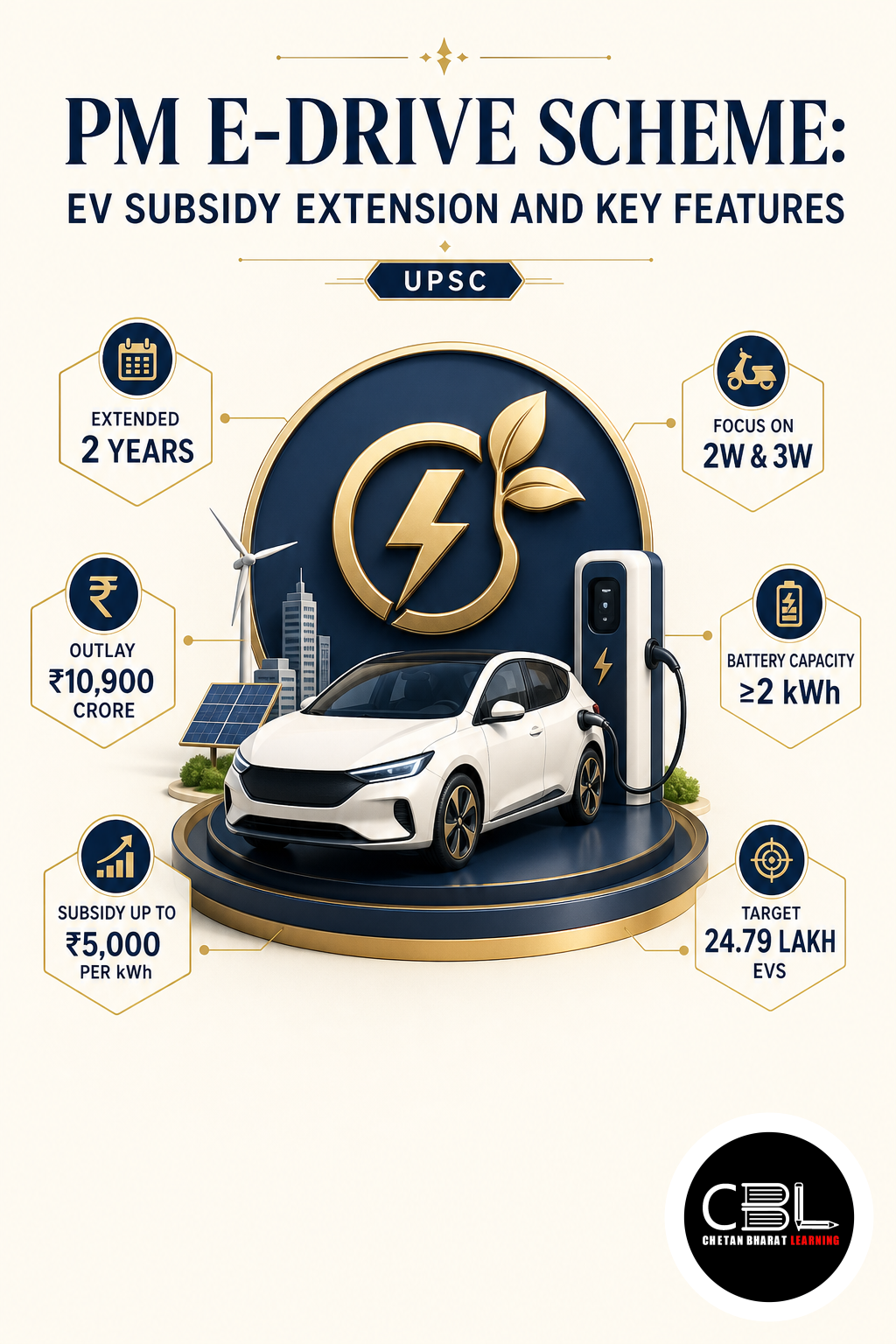
The PM E-Drive Scheme is currently in the news because the government extended the subsidy for electric two-wheelers until 31 March 2028, ensuring continued price support for affordable EVs. The extension comes with a cap of ₹1.5 lakh ex-showroom price and a subsidy structure of ₹2,500 per kWh or up to ₹5,000 per vehicle.
Additionally, a dedicated ₹2,000 crore grant has been allocated for the nationwide rollout of 72,300 fast chargers, split across different vehicle classes. This is a significant push for charging infrastructure, addressing a key barrier to EV adoption. For official updates, refer to the PIB release.
Key Features of the PM E-Drive Scheme
- Targeted Subsidies: Provides upfront price discounts via Aadhaar-authenticated e-vouchers at dealerships, ensuring transparent and instant benefits to buyers.
- Coverage: Includes electric two-wheelers, three-wheelers, ambulances, trucks, and buses, but excludes passenger cars to focus on mass transport segments.
- Truck Scrapping Requirement: Fleet operators must obtain a valid scrapping certificate from an MoRTH-approved center to claim benefits for electric trucks.
- Charging Infrastructure: ₹2,000 crore grant for 72,300 fast chargers, supporting both public and commercial EV fleets.
- Advanced Battery Mandate: Incentives apply only to EVs with lithium-ion or equivalent advanced batteries, promoting modern technology.
Challenges Associated with the PM E-Drive Scheme
- Exclusion of Passenger Cars: The scheme does not cover four-wheelers, which may slow down private EV adoption compared to commercial fleets.
- Infrastructure Gaps: While 72,300 chargers are planned, the distribution and grid capacity across states remain uneven.
- Scrapping Compliance: The truck scrapping requirement may face hurdles due to limited authorised scrapping centres and owner awareness.
- Battery Costs: Despite subsidies, the high cost of lithium-ion batteries keeps EV prices elevated, especially for three-wheelers and trucks.
- Fiscal Burden: Sustaining subsidies over five years places a significant strain on government finances, requiring careful budget allocation.
Way Forward for the PM E-Drive Scheme
To maximise the impact of the PM E-Drive Scheme, the government should gradually extend incentives to passenger cars, while ensuring that the charging network keeps pace with vehicle sales. Public-private partnerships can accelerate charger deployment, especially in Tier-2 and Tier-3 cities.
Strengthening the scrapping ecosystem and providing clearer guidelines for fleet operators will enhance compliance and reduce administrative friction. Additionally, periodic reviews of subsidy rates and battery technology advancements will ensure the scheme remains relevant. A balanced approach—combining fiscal support with regulatory measures like low-emission zones—can drive long-term EV adoption.
Prelims Practice Corner
Q1. Which Ministry administers the PM E-Drive Scheme?
- (a) Ministry of Finance
- (b) Ministry of Heavy Industries – Answer
- (c) Ministry of Power
- (d) Ministry of Road Transport
Q2. What is the maximum subsidy per electric two-wheeler under the extended PM E-Drive Scheme?
- (a) ₹2,500
- (b) ₹5,000 – Answer
- (c) ₹10,000
- (d) ₹15,000
Q3. Which vehicles are excluded from the PM E-Drive Scheme?
- (a) Electric buses
- (b) Electric trucks
- (c) Electric four-wheeler passenger cars – Answer
- (d) Electric three-wheelers
Q4. How many fast chargers are planned under the ₹2,000 crore grant of the scheme?
- (a) 25,000
- (b) 50,000
- (c) 72,300 – Answer
- (d) 100,000
Q5. What condition applies for fleet operators to claim electric truck benefits?
- (a) Minimum 5-year ownership
- (b) Valid scrapping certificate from MoRTH centre – Answer
- (c) Prior registration as a transport company
- (d) Annual turnover above ₹10 crore
Mains Practice Questions
Q1. Critically evaluate the PM E-Drive Scheme in the context of India’s electric mobility transition and its potential to achieve the 2030 EV targets. (250 words, 15 marks)
Intro: Introduce PM E-Drive Scheme as the successor to FAME-II and its objectives.
Body: Discuss strengths: targeted subsidies, charging infrastructure push, scrapping linkage. Analyse weaknesses: exclusion of cars, implementation bottlenecks, fiscal challenges.
Conclusion: Suggest balanced policy with phased expansion and stronger infrastructure coordination.
Q2. Discuss the role of government subsidies and charging infrastructure in accelerating EV adoption in India, with reference to the PM E-Drive Scheme. (150 words, 10 marks)
Intro: Highlight the two pillars of EV adoption – subsidies and charging networks.
Body: Explain how upfront discounts lower purchase costs; discuss the ₹2,000 crore charger grant and its potential to address range anxiety. Mention the scrapping link for trucks.
Conclusion: Conclude that sustained investment in both areas is essential for a robust EV ecosystem.
FAQs on PM E-Drive Scheme
What is the PM E-Drive Scheme?
It is India’s EV incentive programme run by the Ministry of Heavy Industries, replacing FAME-II, covering electric two- and three-wheelers, trucks, buses, and ambulances, with subsidies and charging infrastructure support.
Who is eligible for the electric two-wheeler subsidy?
Individual buyers with Aadhaar-linked mobile numbers can claim a subsidy for one EV per category, for EVs priced up to ₹1.5 lakh, receiving ₹2,500 per kWh or up to ₹5,000 per vehicle.
What is the charging infrastructure component of the scheme?
A ₹2,000 crore grant has been allocated for the installation of 72,300 fast chargers across the country, supporting various vehicle classes.
Related Current Affairs
Preparing for UPSC, PCS or HCS?
Talk to a mentor at Chetan Bharat Learning, Chandigarh. Free guidance on choosing the right exam and building a study plan.
Chat on WhatsAppCall 97793 53345UPSC / IAS / PCS coaching in Chandigarh · Trusted by aspirants across Punjab & Haryana
Leave a Reply
You must be logged in to post a comment.