
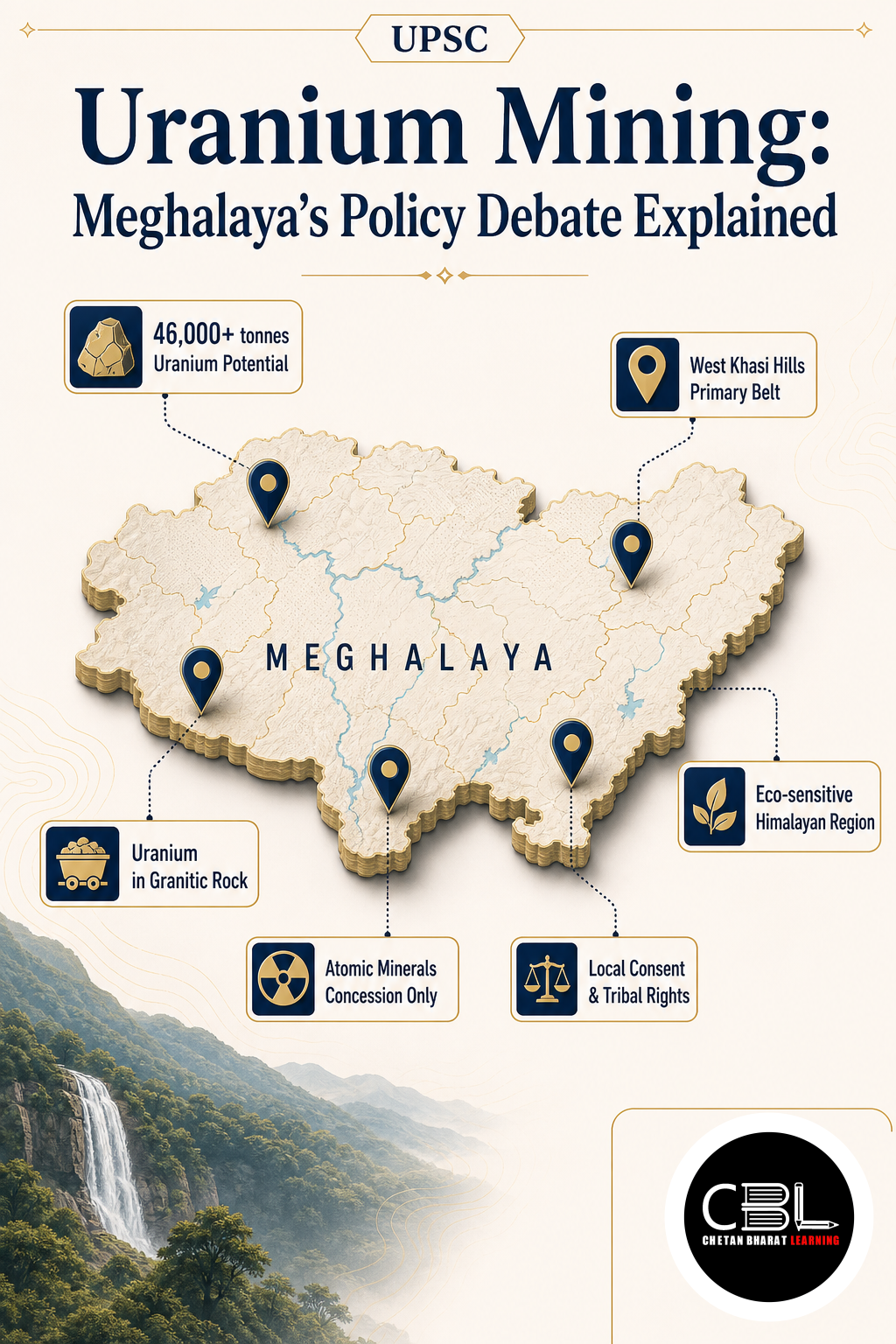

UPSC Mapping
| Aspect | Detail |
|---|---|
| Prelims | Environment, Minerals and Nuclear Energy |
| Mains | GS Paper III – Environment, Energy and Resource Governance |
| State | Meghalaya |
| Key region | Khasi Hills |
| Resource | Uranium |
| Policy issue | Resource development vs local concerns |
What is Uranium Mining?
Uranium Mining refers to the extraction of uranium-bearing ores from the earth for processing and eventual use in the nuclear fuel cycle. Uranium is important because its fissile isotopes support nuclear fission, making the mineral strategically relevant to countries that operate or expand nuclear power programmes.
Mining is only one stage in the nuclear fuel cycle. After extraction, uranium ore requires processing, conversion and enrichment depending on its intended use. This makes uranium a strategic mineral rather than an ordinary commercial resource.
The environmental dimension is significant because mining can disturb land, generate waste and create risks if radioactive materials are not managed carefully. The nature of these risks depends on the geology, mining method, waste-management practices and effectiveness of regulatory safeguards.
In Meghalaya, the debate has an additional social and constitutional dimension. Resource development intersects with tribal land interests, local participation and the special governance framework of the Northeast.
Why is Uranium Mining in News?
Uranium Mining in Meghalaya has returned to public discussion because of renewed attention to uranium-bearing areas in the State. The debate centres on whether Meghalaya should permit uranium extraction given its ecological sensitivity and community concerns.
The central policy question is how India should balance nuclear energy requirements with environmental safeguards and local participation. Meghalaya’s position makes the issue particularly useful for understanding tensions between national priorities and local interests.
This topic also connects with India’s broader effort to strengthen nuclear power and reduce dependence on imported energy resources. Decisions on uranium extraction must account for environmental and social costs alongside strategic benefits.
Geographical and Resource Context
The uranium issue in Meghalaya is located in the Khasi Hills of Northeast India—a region characterised by complex terrain, high rainfall and ecologically important landscapes. Mining in hilly and sensitive terrain can create challenges in land disturbance, water management, transport and waste disposal.
Meghalaya is home to major tribal communities and operates under the Sixth Schedule of the Constitution, which grants special autonomy to tribal areas. As a result, resource decisions can involve environmental regulation as well as community rights and local governance.
Why Uranium Matters for India’s Energy Security
India views nuclear energy as a component of a diversified energy system. Nuclear power offers low operational greenhouse-gas emissions and a stable electricity supply alongside renewables.
Domestic uranium resources can enhance the security of nuclear fuel supply and reduce exposure to international disruptions. However, the nuclear fuel cycle also depends on technology, processing capacity and international arrangements.
A sustainable energy strategy must consider environmental safeguards, community participation, technological capability and long-term waste management alongside resource availability.
Environmental Concerns
Uranium mining can alter landscapes, affect water systems and generate mining waste that may contain radioactive residues. Effective environmental governance requires baseline studies, impact assessment, monitoring, emergency preparedness and post-mining restoration.
Water management is especially important in Meghalaya’s high-rainfall terrain. Poorly managed runoff or waste can harm surrounding ecosystems and communities.
Tribal Rights and Local Participation
Meghalaya’s Sixth Schedule governance framework establishes Autonomous District Councils with legislative, executive and judicial functions over specified tribal areas. This arrangement aims to protect tribal interests and provide self-governance suited to local social and cultural conditions.
Resource development should incorporate affected communities into decision-making. Meaningful consultation improves legitimacy, identifies local concerns and reduces conflict around major projects.
Key Features
- Strategic mineral: Uranium supports nuclear-energy capabilities.
- Ecological sensitivity: Mining in Meghalaya requires careful attention to forests, water and terrain.
- Tribal governance: Sixth Schedule institutions are central to local decision-making.
- Energy security: Domestic uranium resources can strengthen nuclear-fuel resilience.
- Public participation: Transparent consultation and safeguards are essential.
Regulatory Framework and Environmental Governance
Uranium mining sits at the intersection of mineral governance, environmental regulation and the nuclear sector. Regulation should cover the entire project lifecycle—exploration, extraction, processing, transport, waste management, monitoring and site restoration.
Credible compliance mechanisms require technical expertise, monitoring capacity and enforcement resources. Institutional coordination among mining, environment, atomic-energy and local governance bodies is crucial.
Challenges
- Environmental risk: Safeguards against ecological damage and radioactive exposure are essential.
- Community concerns: Impacts on land, livelihoods, forests and water raise local opposition.
- Energy-security pressures: Strategic incentives push for reliable uranium supplies.
- Institutional coordination: Coherent regulation across multiple authorities is required.
- Public trust: Transparency and consultation build legitimacy and reduce conflict.
The central challenge is to avoid a false choice between development and environmental protection. Policy must seek both energy security and ecological sustainability, respecting intergenerational equity.
Way Forward
India needs a science-based, transparent and participatory approach to sensitive mineral development. Decisions on uranium extraction should be supported by credible environmental assessments, robust safety standards and meaningful community engagement.
Regulatory institutions must strengthen monitoring and enforce environmental conditions throughout the project lifecycle. Independent assessments and transparent reporting can improve public confidence.
India’s nuclear-energy strategy should diversify its fuel portfolio, including renewables and efficiency, alongside domestic uranium.
Consultation should be substantive, helping to identify risks, improve project design and establish grievance-redress mechanisms. Sustainable development requires balancing strategic needs with ecological limits and democratic participation.
Prelims Practice Corner
Q1. Consider the following statements about uranium:
- 1. It is important for the nuclear fuel cycle.
- 2. Its extraction can raise environmental and radioactive-waste management concerns.
Options:
- (a) 1 only
- (b) 2 only
- (c) Both 1 and 2
- (d) Neither 1 nor 2
Answer: (c) Both statements are correct.
Q2. The Sixth Schedule of the Constitution applies to tribal areas in which of the following States?
- (a) Assam, Meghalaya, Tripura and Mizoram
- (b) Assam, Nagaland, Manipur and Mizoram
- (c) Meghalaya, Manipur, Tripura and Arunachal Pradesh
- (d) Nagaland, Meghalaya, Sikkim and Mizoram
Answer: (a) The Sixth Schedule applies to specified tribal areas in Assam, Meghalaya, Tripura and Mizoram.
Q3. Why is uranium considered strategically important for India?
- (a) It is used primarily as a construction material
- (b) It forms part of the nuclear fuel cycle
- (c) It is India’s main renewable-energy source
- (d) It is used only in agriculture
Answer: (b) Uranium is an important input in the nuclear fuel cycle.
Q4. Which of the following is most relevant to responsible uranium mining?
- (a) Environmental assessment and radioactive-waste management
- (b) Removal of all local consultation
- (c) Exemption from monitoring
- (d) Unregulated extraction
Answer: (a) Strong environmental assessment and waste-management systems are essential for responsible extraction.
Q5. Which of the following best describes the core policy dilemma in Meghalaya’s uranium debate?
- (a) Tourism versus agriculture only
- (b) Nuclear-energy and resource interests versus environmental and community concerns
- (c) Urbanisation versus manufacturing only
- (d) Trade policy versus monetary policy
Answer: (b) The debate involves strategic energy considerations alongside environmental and community concerns.
Mains Practice Questions
Q1. Uranium resources are strategically important for India’s nuclear-energy security, but their extraction raises environmental and community concerns. Discuss. (10 marks)
Answer Structure:
- Intro: Introduce uranium as a strategic input in the nuclear fuel cycle and frame the development-environment balance.
- Body: Discuss energy security, nuclear power, environmental risks, radioactive waste, Meghalaya’s ecological context, tribal interests, Sixth Schedule institutions, consultation and regulatory capacity.
- Conclusion: Advocate science-based regulation combining energy security with ecological safeguards and meaningful community participation.
Q2. Resource-rich tribal regions often face tensions between national development priorities and local interests. Analyse this issue with reference to Meghalaya. (15 marks)
Answer Structure:
- Intro: Frame Meghalaya’s uranium debate as a case of competing strategic, environmental and community priorities.
- Body: Cover nuclear-energy needs, mineral governance, ecological sensitivity, tribal land and autonomy, Sixth Schedule, environmental assessment, public participation, institutional coordination and intergenerational equity.
- Conclusion: Emphasise participatory and sustainable resource governance rather than treating development and conservation as mutually exclusive.
FAQs on Uranium Mining
Why is uranium important for India?
Uranium is an important input for the nuclear fuel cycle and therefore has strategic relevance for India’s nuclear-energy programme. Domestic resources can contribute to long-term fuel-security objectives.
Why is uranium extraction controversial in Meghalaya?
The controversy involves concerns about environmental impacts, radioactive waste, forests, water and local livelihoods. Meghalaya’s distinctive tribal governance framework also makes questions of community participation and resource use particularly significant.
How is the Sixth Schedule relevant to Meghalaya’s resource debates?
The Sixth Schedule provides autonomous governance arrangements for specified tribal areas in Meghalaya and other northeastern States. It is relevant because resource decisions can intersect with tribal institutions, land interests and local self-governance.
Related Current Affairs
Preparing for UPSC, PCS or HCS?
Talk to a mentor at Chetan Bharat Learning, Chandigarh. Free guidance on choosing the right exam and building a study plan.
Chat on WhatsAppCall 97793 53345UPSC / IAS / PCS coaching in Chandigarh · Trusted by aspirants across Punjab & Haryana
Leave a Reply
You must be logged in to post a comment.