

UPSC Mapping
| Exam | Topics |
|---|---|
| Prelims | Tiger Reserves, Wildlife Protection Act, Project Tiger |
| Mains | GS Paper III – Environment, Biodiversity and Wildlife Conservation |
Key Facts
| States | Madhya Pradesh & Maharashtra |
|---|---|
| Protected Link | Satpura–Melghat Corridor |
| Legal Basis | Wildlife Protection Act, 1972 |
| Project Area | 206.09 Hectares |
Article
What is Tiger Corridor?
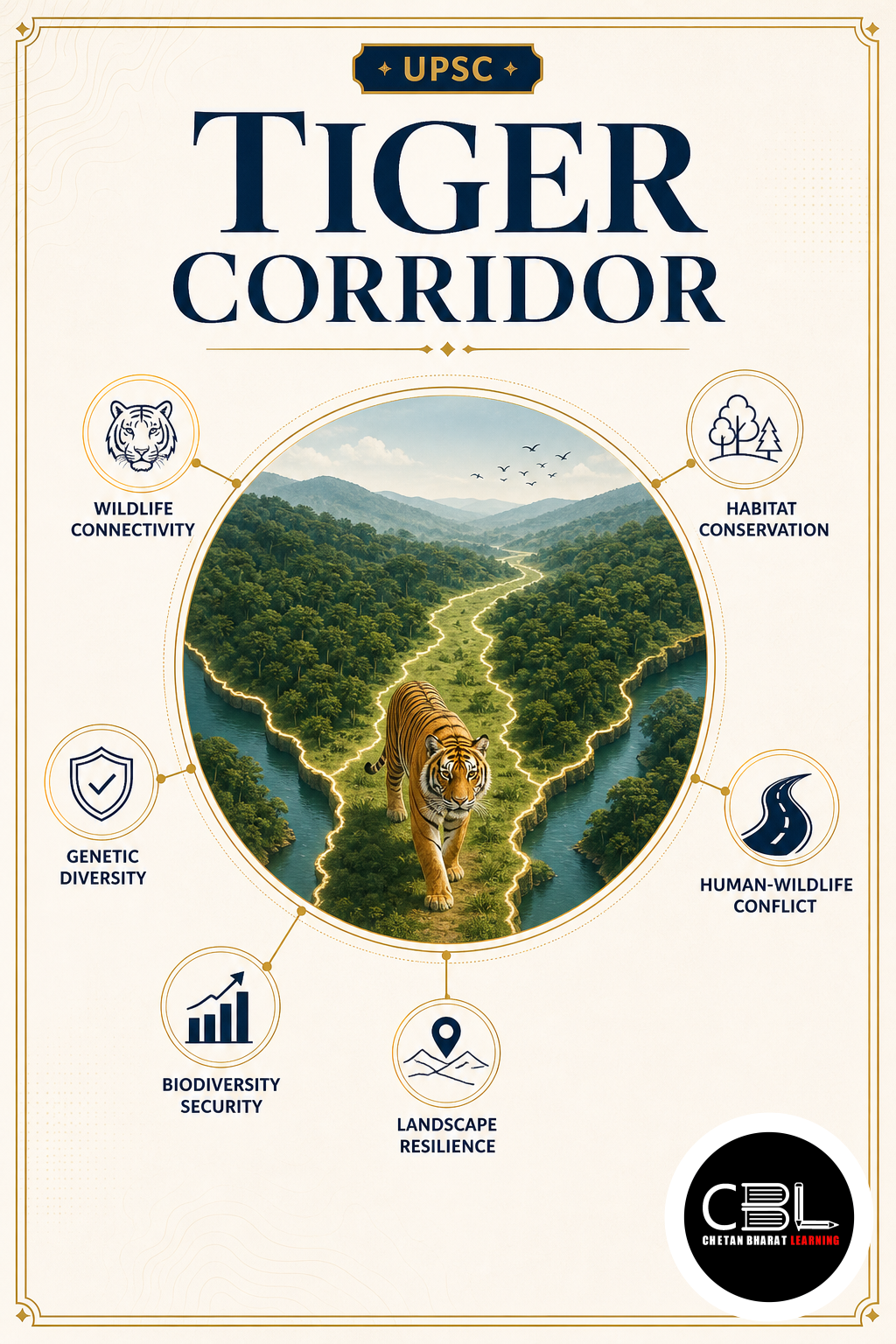
Tiger Corridor refers to a natural habitat link that connects separate tiger habitats and protected areas, enabling the safe movement of wildlife between them. These corridors facilitate the dispersal of tigers and other wildlife populations, ensuring long-term ecological connectivity and genetic exchange.
Besides tigers, these corridors also provide movement pathways for leopards, herbivores, sloth bears and several other wildlife species.
Why is Tiger Corridor in News?
An in-principle wildlife clearance has been recommended for the proposed third railway line between Jujharpur and Chichonda in Madhya Pradesh. The project involves approximately 206.09 hectares of land, including 74.69 hectares of forest land, located within the notified tiger corridor connecting the Satpura Tiger Reserve in Madhya Pradesh and the Melghat Tiger Reserve in Maharashtra.
Further information on wildlife conservation is available through the National Tiger Conservation Authority (ntca.gov.in).
Key Features
- Wildlife connectivity: Provides safe movement pathways for tigers, leopards, herbivores, sloth bears and other wildlife.
- Genetic diversity: Facilitates dispersal between habitats, preventing genetic isolation and maintaining healthy wildlife populations.
- Landscape conservation: Connects multiple protected areas and supports ecological processes across larger landscapes.
- Legal protection: Under the Wildlife Protection Act, 1972, development projects involving land in or around tiger reserves or corridors require statutory clearance from the Standing Committee of the National Board for Wildlife.
- Project Tiger support: Corridors strengthen the objectives of Project Tiger by ensuring habitat connectivity between tiger reserves.
About Tigers in India
- Scientific name: Panthera tigris.
- Wildlife Protection Act, 1972: Listed under Schedule I.
- IUCN Red List: Endangered.
- CITES: Included in Appendix I.
- Habitats: Found in tropical rainforests, evergreen forests, temperate forests, mangrove swamps, grasslands and savannas.
- Major tiger landscapes: Shivalik-Gangetic Plains, Central India and Eastern Ghats, Western Ghats, North Eastern Hills and Brahmaputra Flood Plains, and the Sundarbans.
Challenges
- Habitat fragmentation: Railways, highways and other infrastructure projects can disrupt wildlife movement.
- Human-wildlife conflict: Reduced connectivity may increase encounters between wildlife and human settlements.
- Conservation planning: Development projects require careful ecological assessment and mitigation measures.
- Long-term monitoring: Effective corridor management requires scientific monitoring and coordinated landscape-level conservation.
- UPSC relevance: Tiger corridors remain an important topic in biodiversity and environmental governance.
Way Forward
Infrastructure development and wildlife conservation should progress through integrated landscape planning, scientific impact assessments and effective mitigation measures such as wildlife crossings. Maintaining habitat connectivity remains essential for long-term tiger conservation.
For UPSC, candidates should remember the Satpura–Melghat corridor, legal provisions under the Wildlife Protection Act, Project Tiger, tiger conservation status and major tiger landscapes in India. Additional information is available through the Ministry of Environment, Forest and Climate Change (moef.gov.in).
Prelims Practice Corner
- Q1. The tiger corridor recently in the news connects: (a) Kanha and Bandhavgarh (b) Satpura and Melghat (c) Corbett and Rajaji (d) Nagarhole and Bandipur
Answer: (b) - Q2. Under the Wildlife Protection Act, 1972, projects affecting tiger corridors require clearance from: (a) Central Empowered Committee (b) National Green Tribunal (c) Standing Committee of the National Board for Wildlife (d) State Wildlife Board only
Answer: (c) - Q3. Tigers are listed under which Schedule of the Wildlife Protection Act, 1972? (a) Schedule I (b) Schedule II (c) Schedule III (d) Schedule IV
Answer: (a) - Q4. The IUCN conservation status of the tiger is: (a) Vulnerable (b) Near Threatened (c) Endangered (d) Critically Endangered
Answer: (c) - Q5. Which of the following is NOT listed as a major tiger landscape in India? (a) Western Ghats (b) Sundarbans (c) Central India and Eastern Ghats (d) Thar Desert
Answer: (d)
Mains Practice Questions
-
Q1. Discuss the ecological significance of tiger corridors in maintaining biodiversity and ensuring long-term wildlife conservation. (10 Marks)
- Intro: Define tiger corridors.
- Body: Explain habitat connectivity, genetic flow, biodiversity conservation and infrastructure challenges.
- Conclusion: Highlight the need for landscape-level conservation.
-
Q2. Examine the challenges of balancing infrastructure development with wildlife conservation in India. (15 Marks)
- Intro: Explain the importance of sustainable infrastructure.
- Body: Discuss ecological impacts, legal safeguards, mitigation measures and conservation planning.
- Conclusion: Emphasise balanced development with biodiversity protection.
FAQs on Tiger Corridor
- What is a tiger corridor?
- A tiger corridor is a natural habitat link connecting separate tiger habitats and protected areas, allowing safe movement of tigers and other wildlife while maintaining genetic diversity.
- Why are tiger corridors important?
- They reduce habitat fragmentation, facilitate wildlife dispersal, maintain genetic flow and strengthen long-term conservation of tigers and associated species.
- Which law protects tiger corridors in India?
- Development projects affecting tiger reserves or notified tiger corridors require statutory clearance under the Wildlife Protection Act, 1972 from the Standing Committee of the National Board for Wildlife.
Related Current Affairs
Preparing for UPSC, PCS or HCS?
Talk to a mentor at Chetan Bharat Learning, Chandigarh. Free guidance on choosing the right exam and building a study plan.
Chat on WhatsAppCall 97793 53345UPSC / IAS / PCS coaching in Chandigarh · Trusted by aspirants across Punjab & Haryana
Leave a Reply
You must be logged in to post a comment.