
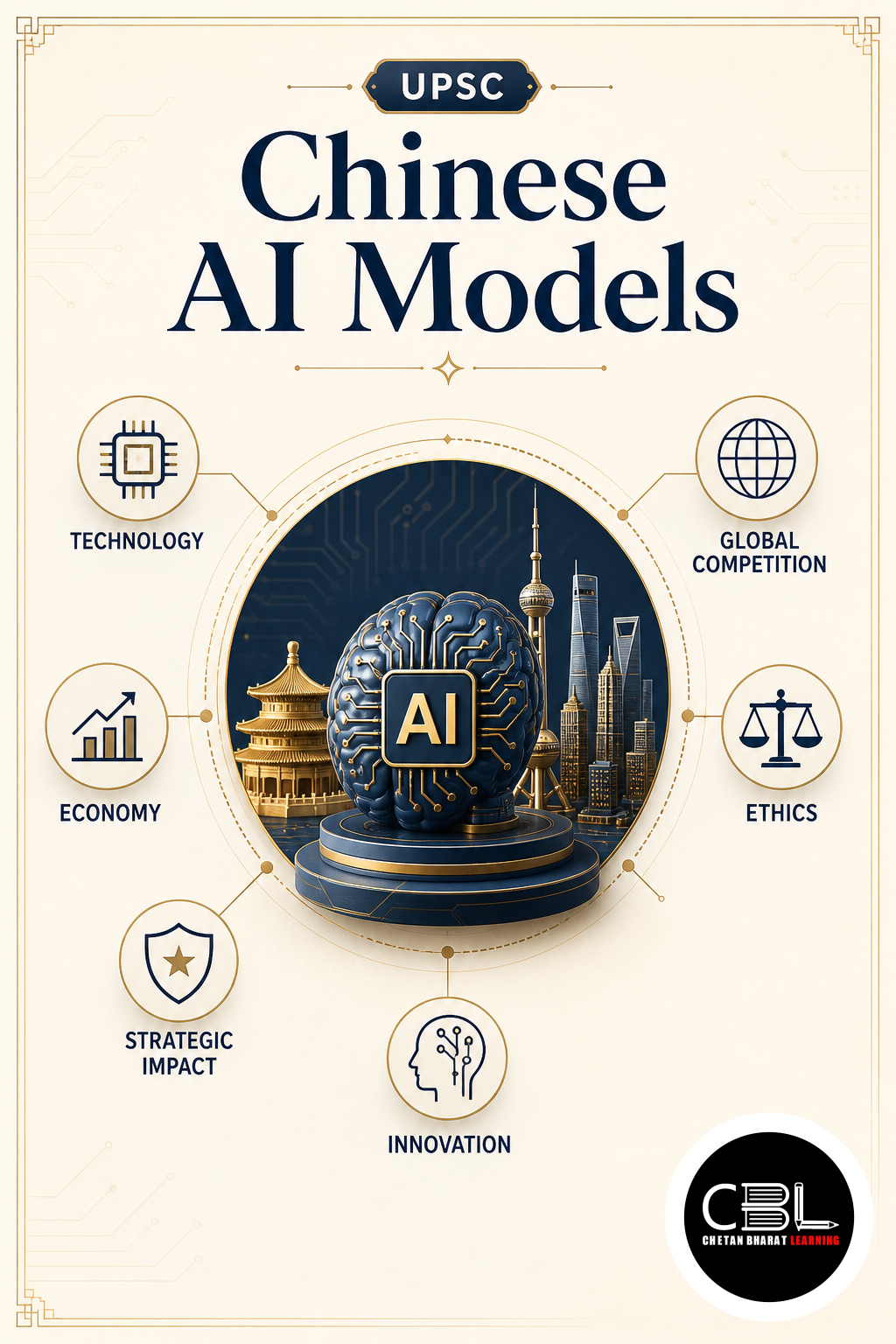

Chinese AI Models
Chinese AI Models are in the news after the passage discussed whether recent advances by Chinese artificial intelligence companies could reshape the global technology race. The accompanying infographic highlights new open-weight AI models, competition in large language models and their strategic implications. For related topics, visit the daily current affairs archive.
UPSC Mapping
| Important for |
|---|
| Prelims: Artificial Intelligence, LLMs, Open-weight Models, Semiconductors |
| Mains: GS Paper III – Science & Technology, Emerging Technologies and Digital Governance |
| Key Players | DeepSeek, Moonshot AI |
|---|---|
| Theme | AI competition and open-weight models |
What are Chinese AI Models?
Chinese AI Models refer to artificial intelligence systems developed by Chinese technology companies. The uploaded infographic explains that Artificial Intelligence (AI) enables machines to perform tasks such as understanding language, solving problems, decision-making and content generation.
The source also introduces Large Language Models (LLMs), explaining that they are trained on massive amounts of text to predict the next word or token and improve language understanding. It notes that model performance generally improves with larger parameter counts, better data, stronger architectures and greater computing power.
Why are Chinese AI Models in News?
The passage discusses whether recent advances by Chinese AI companies could reshape global technological competition. The accompanying infographic highlights DeepSeek, which is described as delivering high performance at lower cost, and Moonshot AI, whose open-weight model is presented as another significant development.
The source further states that the wider competition extends beyond AI models to chips, data centres, cloud computing, talent, standards and software ecosystems. Official policy developments may be tracked through the Ministry of Electronics and Information Technology (MeitY).
Key Features
- Generative AI: Produces new text, images, videos, music and computer code instead of only analysing existing data.
- Open-weight models: Developers can download and fine-tune model weights locally. The source clarifies that open-weight does not necessarily mean open-source.
- Training process: AI models learn by reading books, websites, research papers, code and articles, gradually adjusting parameters to improve predictions.
- Open-weight vs closed models: The infographic contrasts publicly available weights with proprietary models controlled by developers.
- Strategic competition: The US–China AI race includes AI models, chips, cloud infrastructure, data centres, talent and technical standards.
Challenges
- Semiconductor dependence: Advanced AI requires powerful computer chips for training and inference.
- Technology competition: AI leadership increasingly depends on computing infrastructure and research ecosystems.
- Digital sovereignty: Countries seek greater control over critical digital technologies, AI systems and platforms.
- Strategic resources: The infographic describes semiconductors as the ‘new oil’ because they power AI, quantum computing and advanced electronics.
- Global rivalry: Competition now extends beyond software to manufacturing capacity, standards and ecosystem development.
Way Forward
The uploaded infographic suggests that India should build indigenous AI capabilities by developing semiconductor manufacturing, expanding compute infrastructure, investing in skilled human resources and promoting responsible AI.
The source presents the broader objective as achieving technological self-reliance while participating in global AI innovation. Readers should monitor future AI policy initiatives through the IndiaAI Mission.
Prelims Practice Corner
- Q1. According to the uploaded infographic, a Large Language Model (LLM) is primarily trained on: (b) Massive amounts of text.
- Q2. Open-weight AI models allow developers to: (b) Download and fine-tune model weights.
- Q3. According to the uploaded infographic, advanced AI critically depends on: (b) Semiconductors.
- Q4. Which of the following is identified as part of the US–China AI competition? (d) All of the above.
- Q5. According to the uploaded source, technological sovereignty refers to: (b) Developing and controlling critical technologies without excessive dependence.
Mains Practice Questions
- Q1. Examine the strategic importance of Artificial Intelligence and semiconductor capabilities in shaping global technological competition. (15 Marks)
- Answer Structure: Intro – AI as strategic technology; Body – AI models, semiconductors, infrastructure, sovereignty; Conclusion – innovation with responsible governance.
- Q2. Discuss the significance of open-weight AI models for innovation and technological development. (10 Marks)
- Answer Structure: Intro – Define open-weight AI; Body – Accessibility, experimentation, customisation, challenges; Conclusion – balanced AI ecosystem.
FAQs on Chinese AI Models
What is an open-weight AI model?
It is a model whose trained weights are publicly available for developers to download and fine-tune, though it is not necessarily open-source.
Why are semiconductors important for AI?
Advanced AI depends on semiconductors for training, inference and high-performance computing.
What measures does the uploaded infographic suggest for India?
Building indigenous AI capabilities, developing semiconductor manufacturing, expanding compute infrastructure, investing in skilled talent and promoting responsible AI.
Related Current Affairs
Preparing for UPSC, PCS or HCS?
Talk to a mentor at Chetan Bharat Learning, Chandigarh. Free guidance on choosing the right exam and building a study plan.
Chat on WhatsAppCall 97793 53345UPSC / IAS / PCS coaching in Chandigarh · Trusted by aspirants across Punjab & Haryana
Leave a Reply
You must be logged in to post a comment.