
UPSC Syllabus Mapping
- GS Paper: GS-II and GS-III
- Subject: Poverty and Hunger; Human Development; Food Security
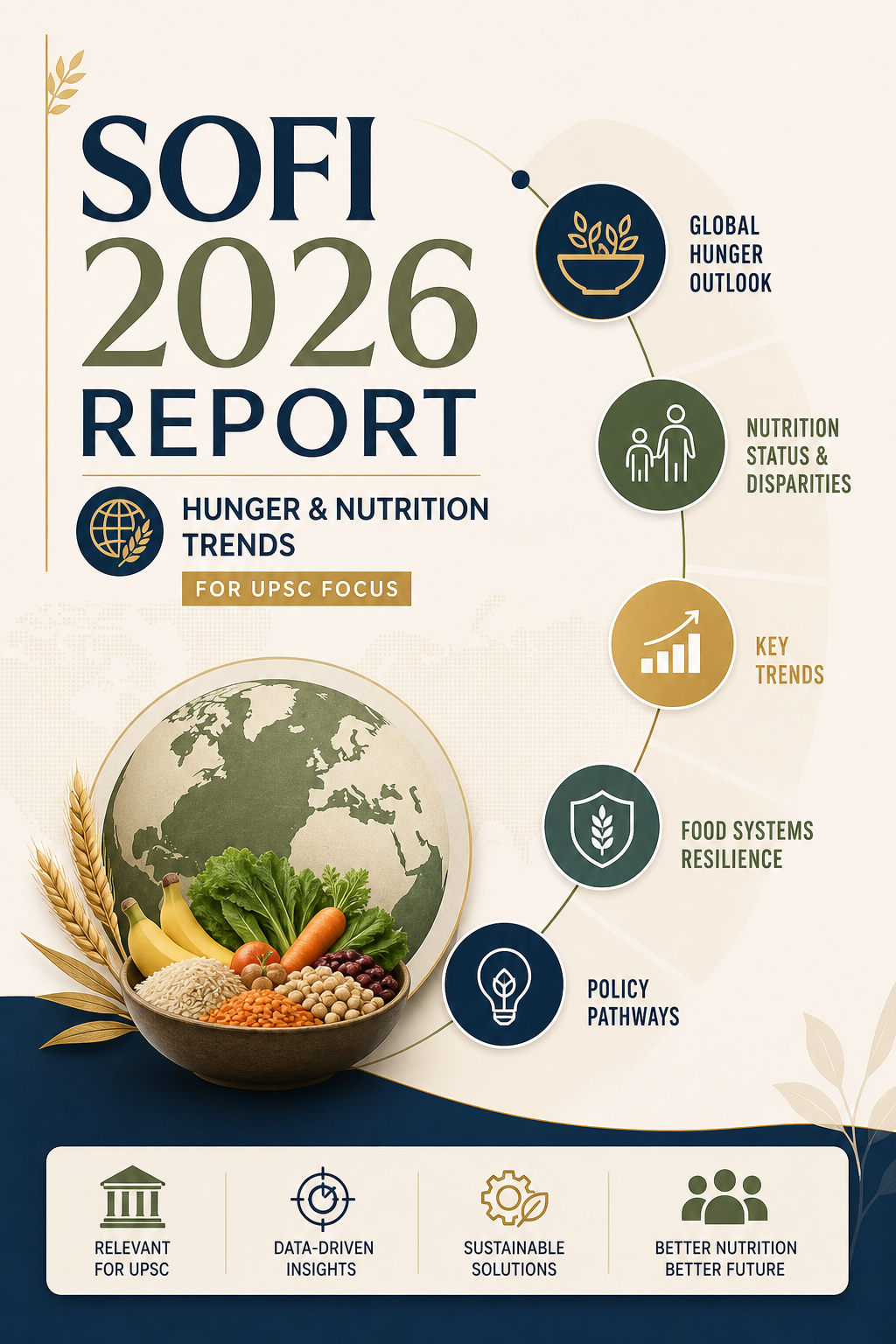
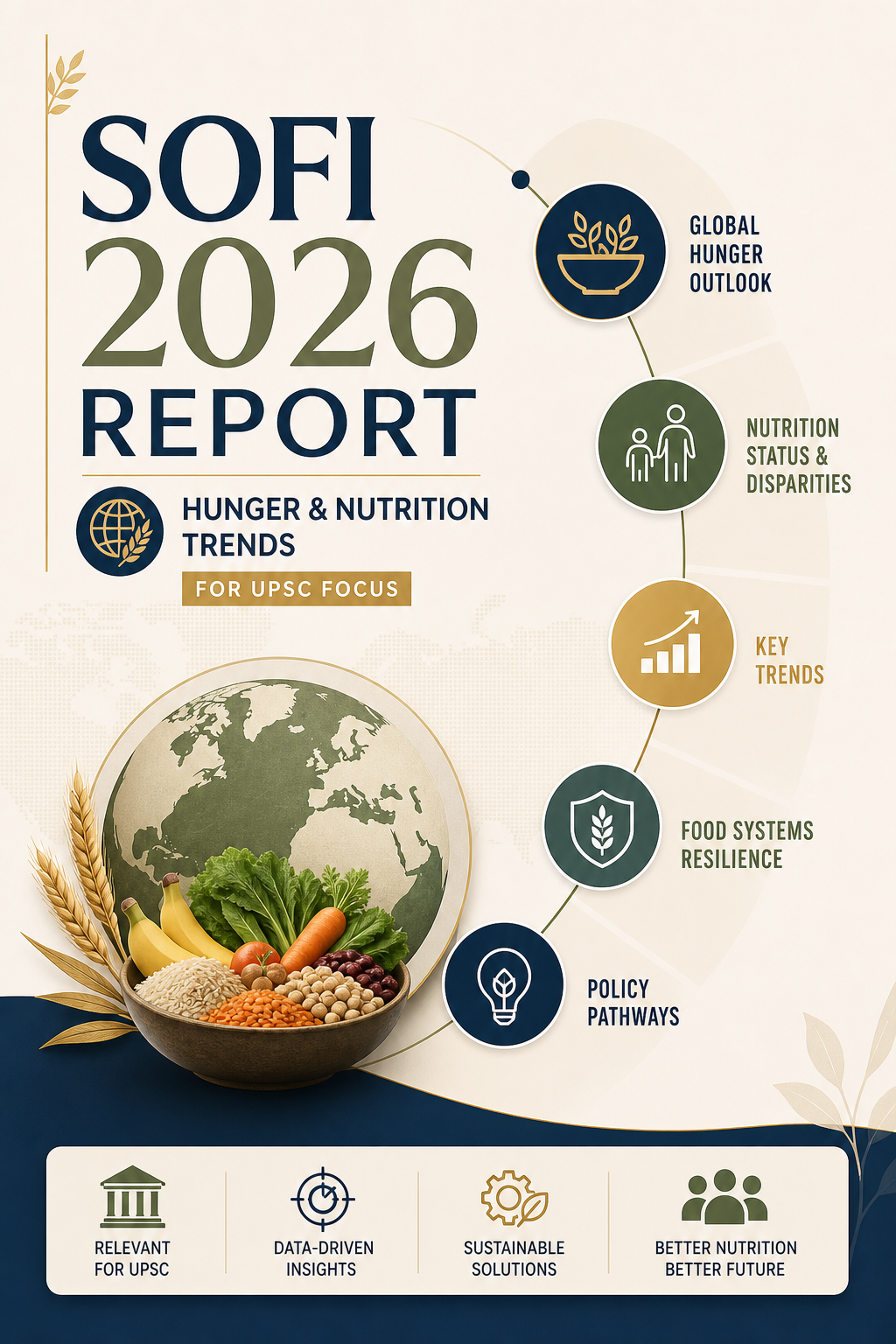
What is SOFI 2026 Report?
The State of Food Security and Nutrition in the World is the UN system’s flagship assessment of hunger, food insecurity and malnutrition. It is jointly prepared by the Food and Agriculture Organization, International Fund for Agricultural Development, UNICEF, World Food Programme and World Health Organization. The publication tracks progress towards Sustainable Development Goal 2, particularly SDG Target 2.1 on ending hunger and ensuring access to safe, nutritious and sufficient food, and Target 2.2 on ending all forms of malnutrition.
The 2026 edition focuses on understanding and addressing the high cost of a healthy diet. This shifts attention beyond calorie availability towards whether households can economically access diverse and nutritious foods. The distinction matters because food security includes availability, access, utilisation and stability. A population may have adequate staple calories while still experiencing micronutrient deficiencies or poor dietary diversity because fruits, vegetables and other nutrient-dense foods remain unaffordable.
Why is SOFI 2026 Report in News?
The five UN agencies released the latest edition in July 2026. According to the official findings, about 7.8% of the global population faced hunger in 2025, compared with 8.1% in 2024. Around 645 million people experienced hunger, while approximately 2.1 billion people faced moderate or severe food insecurity. The figures indicate improvement at the global level but also underline substantial regional inequalities.
The report estimates that about 2.69 billion people were unable to afford a healthy diet in 2025. Africa faced a particularly severe affordability challenge, with roughly two-thirds of its population unable to afford one. The report therefore links hunger and malnutrition not merely to food production but also to incomes, prices and structural costs across agrifood systems.
Key Global and India Findings
Regional divergence is among the most important findings. Africa accounted for about 309 million people facing hunger in 2025, compared with around 292 million in Asia. Rural populations also remained more vulnerable to food insecurity than urban populations. These differences demonstrate how conflict, poverty, infrastructure constraints, economic conditions and the resilience of food systems can produce sharply different outcomes even when the global average improves.
Diet quality remains another concern. The high cost of nutrient-dense food groups can make a balanced diet inaccessible even where basic staples remain affordable. Poor dietary diversity among young children and women reinforces the need to examine food security through a nutrition-sensitive lens. Meanwhile, anaemia among women and rising adult obesity illustrate the multiple burden of malnutrition: undernutrition, micronutrient deficiencies and overweight or obesity can coexist within countries and even households.
India is important to the regional picture because improvements in the country contributed to declining undernourishment and food insecurity in Southern Asia. The report indicates that Southern Asia’s prevalence of undernourishment fell from 13.9% in 2021 to 9.3% in 2025. India also has considerable influence on affordability trends within the lower-middle-income country group because of its large population.
For UPSC analysis, India’s experience demonstrates that reducing hunger and improving nutrition are related but distinct policy objectives. Progress in child nutrition indicators can coexist with continuing challenges such as maternal anaemia and the affordability of diverse diets. This makes nutrition-sensitive agriculture, social protection, public health interventions and efficient food markets complementary components of food-security policy.
Challenges Related to Food Security
The cost of a healthy diet reflects pressures throughout the agrifood value chain. Perishable foods such as fruits and vegetables require reliable transport, storage, refrigeration and market infrastructure. Weak cold chains and rural connectivity can increase losses and consumer prices. Climate variability can further disrupt production and supply, while energy and fertiliser price shocks can raise cultivation and distribution costs. Conflict and economic instability compound these vulnerabilities in already food-insecure regions.
Agricultural incentives also influence what farmers produce and what consumers can afford. When policy support disproportionately favours a limited range of staple commodities, production of pulses, fruits, vegetables and other nutrient-rich foods may receive insufficient attention. At the household level, poverty restricts dietary choices, making inexpensive calorie-dense foods more attractive than diverse diets.
The 2030 deadline presents an additional challenge. Current trajectories indicate that hundreds of millions of people could continue facing chronic hunger by the end of the decade. Progress must therefore be judged not only by declining global averages but also by whether vulnerable regions, women, children and rural communities experience sufficiently rapid improvements. This connects food security directly with inclusive development and the principle of leaving no one behind under the Sustainable Development Goals.
Way Forward for Affordable Healthy Diets
The SOFI 2026 Report highlights the need to address structural costs that prevent nutritious food from reaching consumers at affordable prices. Investment in cold storage, rural roads, processing facilities, reliable energy and efficient logistics can reduce losses and distribution costs, particularly for perishable products. Agricultural research can similarly devote greater attention to nutritious non-staple crops, productivity improvements and climate resilience.
Public support to agriculture can be made more nutrition-sensitive by balancing food-security objectives with incentives for diversified production. Governments can also strengthen monitoring of the cost and affordability of healthy diets using reliable retail-price and household data. Well-designed social protection, including nutrition-sensitive transfers, can protect vulnerable families when food prices or incomes experience sudden shocks.
A durable strategy must combine agricultural productivity with affordability, dietary diversity, women’s nutrition and resilient supply chains. International cooperation remains important because conflicts, commodity markets, climate shocks and financing constraints cross national boundaries. For India, the broader policy lesson is to connect food availability with nutrition outcomes so that food security progressively evolves towards nutrition security.
Prelims Practice Corner
Q1. The State of Food Security and Nutrition in the World is jointly produced by which of the following?
1. FAO
2. IFAD
3. UNICEF
4. WFP
5. WHO
(a) 1, 2 and 3 only
(b) 1, 3, 4 and 5 only
(c) 1, 2, 3, 4 and 5
(d) 2, 4 and 5 only
Answer
(c) All five organisations jointly produce the report.
Q2. SOFI primarily monitors progress towards which Sustainable Development Goal?
(a) SDG 1
(b) SDG 2
(c) SDG 3
(d) SDG 12
Answer
(b) SDG 2, which seeks to end hunger, achieve food security and improved nutrition, and promote sustainable agriculture.
Q3. Which region had the largest number of people facing hunger in 2025 according to the report?
(a) Asia
(b) Africa
(c) Europe
(d) Latin America
Answer
(b) Africa, with about 309 million people facing hunger.
Q4. Consider the following statements: 1. Food insecurity was higher in rural areas than urban areas globally. 2. Affordability of a healthy diet depends only on agricultural production. Which is correct?
(a) 1 only
(b) 2 only
(c) Both 1 and 2
(d) Neither 1 nor 2
Answer
(a) Statement 1 is correct. Diet affordability also depends on incomes, prices, transport, processing and other food-system factors.
Q5. SDG Target 2.2 is concerned primarily with:
(a) Ending all forms of malnutrition
(b) Universal primary education
(c) Renewable energy access
(d) Sustainable urbanisation
Answer
(a) SDG Target 2.2 concerns ending all forms of malnutrition.
Mains Practice Questions
Q1. Food availability does not necessarily ensure nutrition security. Discuss in the context of the rising cost of healthy diets. (10 marks)
Outline:
- Define food and nutrition security
- Explain affordability and dietary diversity
- Discuss poverty, food prices and supply-chain constraints
- Highlight women and child nutrition
- Conclude with nutrition-sensitive food systems and social protection
Q2. Examine the structural challenges to achieving Zero Hunger by 2030 and suggest measures to make healthy diets affordable. (15 marks)
Outline:
- Introduce SDG 2
- Analyse regional disparities, poverty, climate risks, conflict and value-chain costs
- Discuss agricultural incentives and infrastructure
- Propose diversified production, R&D, cold chains, social protection and better monitoring
- Conclude with integrated agrifood-system transformation
FAQs on Global Food Security
Who publishes the annual SOFI publication?
It is jointly produced by FAO, IFAD, UNICEF, WFP and WHO as the UN system’s flagship assessment of global hunger, food insecurity and malnutrition.
What is the central theme of the 2026 edition?
It focuses on understanding and addressing the high cost of a healthy diet, including economic and structural factors that prevent people from accessing nutritious food.
Why is the report important for India and UPSC?
It provides evidence for studying poverty, hunger, nutrition, food security and SDG 2 while showing India’s importance to improving Southern Asian trends and the continuing challenge of ensuring affordable, diverse and nutritious diets.
Related Current Affairs
Preparing for UPSC, PCS or HCS?
Talk to a mentor at Chetan Bharat Learning, Chandigarh. Free guidance on choosing the right exam and building a study plan.
Chat on WhatsAppCall 97793 53345UPSC / IAS / PCS coaching in Chandigarh · Trusted by aspirants across Punjab & Haryana
Leave a Reply
You must be logged in to post a comment.