
Important for:
UPSC, Haryana HCS, Punjab PCS
Prelims: Left Wing Extremism (LWE), Red Corridor, affected states
Mains: GS Paper 3 — Internal Security, LWE, Development vs Security
Why in News?
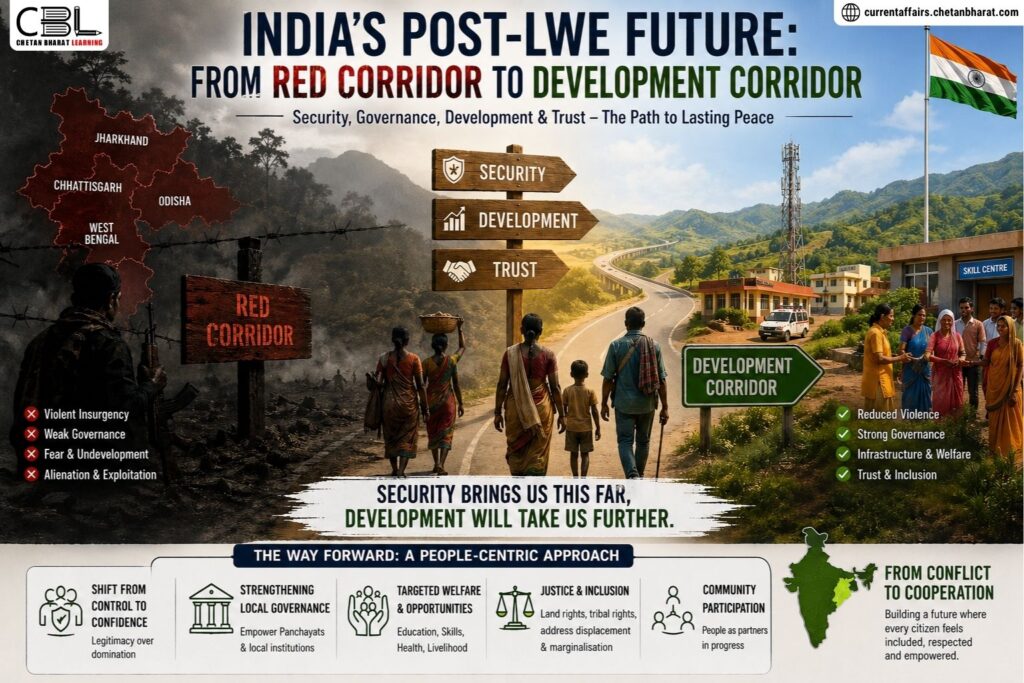
An editorial highlights India’s transition from tackling Left Wing Extremism (LWE) through security measures to focusing on long-term governance, development, and trust-building in affected regions.
What is Left Wing Extremism (LWE)?
- Also known as:
✔︎ Naxalism - Ideology:
✔︎ Maoist-inspired insurgency - Goal:
✔︎ Overthrow state authority through armed struggle
Key areas:
- Chhattisgarh
- Jharkhand
- Odisha
- Parts of Maharashtra & Andhra Pradesh
From Red Corridor to Stability
Earlier:
- Violent insurgency
- Weak governance
- Fear and underdevelopment
Now:
- Significant decline in violence
- Improved security presence
- Administrative reach expanding
✔️ The article notes that:
Security success alone is not enough — it must lead to development and legitimacy
Phase 1: Security-Centric
- Counter-insurgency operations
- Deployment of forces
- Elimination of militant networks
Phase 2: Development-Oriented
- Infrastructure development
- Welfare schemes
- Administrative outreach
Phase 3: Trust-Building (Current Focus)
- Community participation
- Institutional strengthening
- Inclusive governance
Key Policy Framework Suggested
1. Shift from “Control” to “Confidence”
- Move beyond security domination
- Focus on legitimacy of state
2. Strengthening Local Governance
- Empower:
- Panchayats
- Local institutions
✔︎ Linked to:
- Grassroots democracy
- Tribal rights
3. Targeted Welfare Schemes
Examples include:
- Aspirational District Programme
- Skill development missions
4. Justice & Inclusion
- Address:
- Land rights
- Displacement issues
- Tribal marginalisation
Core Issue (Mains Perspective)
| Security Approach | Development Approach |
|---|---|
| Military operations | Welfare + governance |
| Short-term stability | Long-term peace |
| Force-based control | Trust-based integration |
Key Insight (VERY IMPORTANT)
✔️ LWE decline = Opportunity window
If governance fails now:
- Risk of resurgence
If handled well:
- Permanent peace + development
India-Specific Dimension
- LWE linked with:
- Tribal alienation
- Resource exploitation
- Governance gaps
✔️ Solution requires:
- Balance between:
- Security
- Development
- Justice
PRELIMS PRACTICE QUESTIONS
Q1. Left Wing Extremism is associated with:
A. Religious extremism
B. Maoist ideology
C. Capitalist movements
D. Foreign invasions
✅ Answer: B
Q2. Which of the following states are LWE affected?
- Chhattisgarh
- Jharkhand
- Punjab
A. 1 and 2 only
B. 2 and 3 only
C. 1 only
D. 1, 2 and 3
✅ Answer: A
Q3. Red Corridor refers to:
A. Industrial region
B. Coastal belt
C. LWE affected areas
D. Trade route
✅ Answer: C
Q4. Aspirational District Programme is related to:
A. Defence
B. Education only
C. Development of backward districts
D. Foreign policy
✅ Answer: C
Q5. LWE is mainly linked with:
A. Urbanisation
B. Tribal issues
C. Banking sector
D. Trade policy
✅ Answer: B
Q6. Which ministry handles LWE in India?
A. Ministry of Defence
B. Ministry of Home Affairs
C. Ministry of Finance
D. Ministry of Agriculture
✅ Answer: B
CBL Mains Practice Question
“Security gains against Left Wing Extremism must be consolidated through development and governance reforms.”
Discuss. (250 words)
FAQs
1. What is LWE?
It is a Maoist insurgency aimed at challenging state authority.
2. What is Red Corridor?
Regions heavily affected by Naxalite insurgency.
3. Why has LWE declined?
Due to security operations and improved governance.
4. What is the future strategy?
Focus on development, inclusion, and trust-building.
5. Which GS paper covers this topic?
GS Paper 3 — Internal Security.
Related Current Affairs
Preparing for UPSC, PCS or HCS?
Talk to a mentor at Chetan Bharat Learning, Chandigarh. Free guidance on choosing the right exam and building a study plan.
Chat on WhatsAppCall 97793 53345UPSC / IAS / PCS coaching in Chandigarh · Trusted by aspirants across Punjab & Haryana
Leave a Reply
You must be logged in to post a comment.