
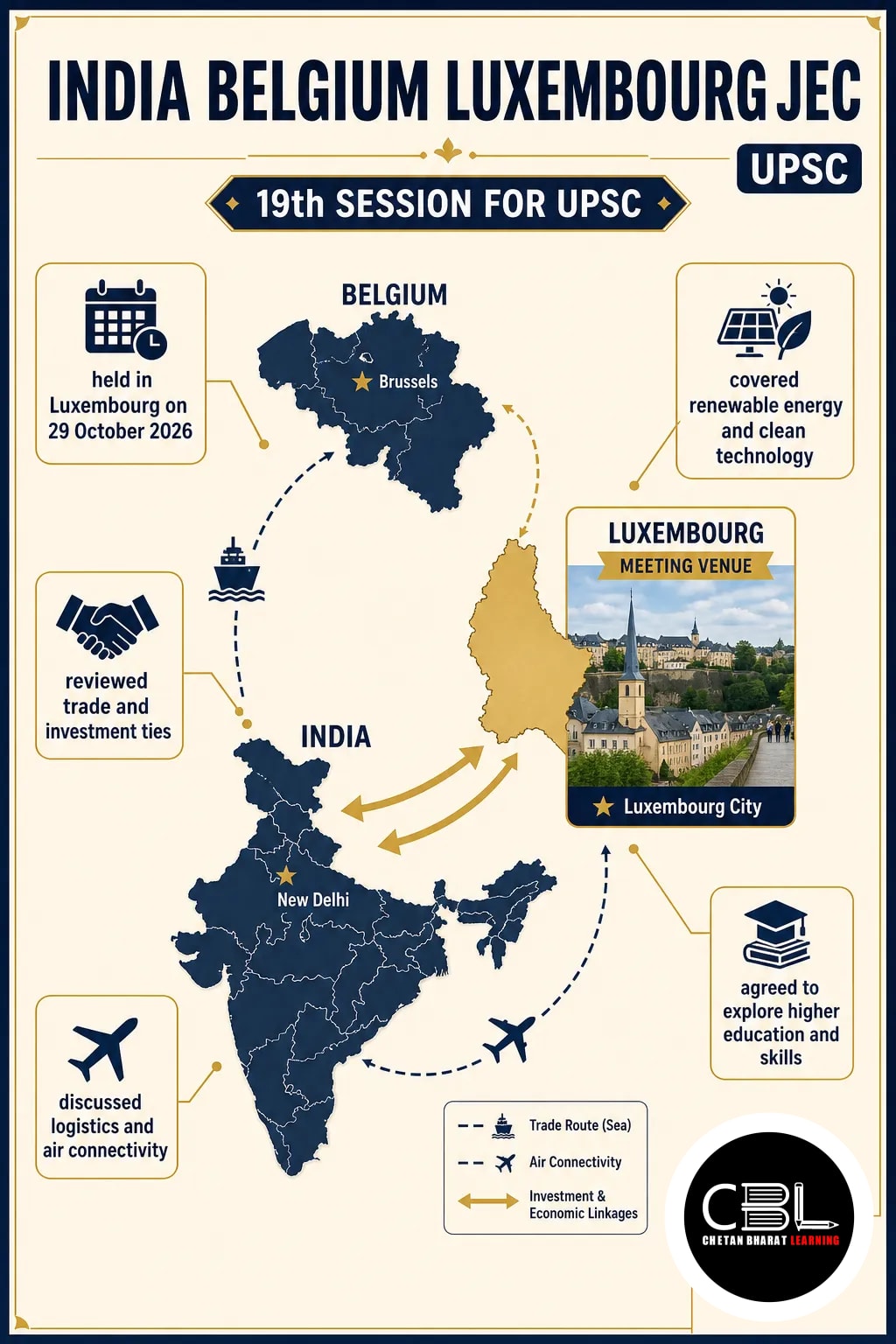

India Belgium Luxembourg JEC talks in Luxembourg brought trade, investment and technology cooperation into focus. The meeting offers a case study in India’s economic diplomacy for UPSC.
Quick answer: The India Belgium Luxembourg JEC held its 19th session in Luxembourg on 29 October 2026. India and the Belgium-Luxembourg Economic Union reviewed trade and investment ties. They discussed market access, logistics, clean technology and financial services, and agreed to explore cooperation in research, education, skills, aviation and space.
What happened at the 19th session?
The Joint Economic Commission (JEC) reviewed economic ties between India and the Belgium-Luxembourg Economic Union (BLEU). On 29 October, the three sides discussed ways to facilitate trade and investment flows and address market-related concerns.
Commerce Secretary Rajesh Agrawal co-chaired the session for India. Belgium’s co-chair was Philippe Vanden Bulcke, Director General for Geo-Economy and Economic Diplomacy. Luxembourg’s co-chair was Henry Schumacher, Secretary General of its foreign affairs ministry.
Afterwards, Agrawal met chief executive officers of Luxembourg-based companies. He encouraged them to explore long-term investment, technology partnerships and integration with Indian firms to meet global value-chain needs.
What were the key outcomes?
The meeting identified areas for cooperation and agreed to explore additional partnerships, rather than announcing specific projects.
| Area | Discussion at the session |
|---|---|
| Connectivity | Logistics, particularly air connectivity and ports |
| Energy and finance | Renewable energy, clean technology, financial services and financial technology |
| Digital economy and health | Digital transformation, information and communication technology, healthcare, life sciences and Ayurveda |
| Food and agriculture | Agriculture and food processing |
| Further opportunities | Aviation, space, research, innovation, higher education and skills |
The India Belgium Luxembourg JEC also discussed market access and trade concerns. However, the source does not specify individual barriers or announce their resolution.
Why does the session matter for India?
The session connects India’s trade objectives with investment, technology and business partnerships. Its significance lies in the range of economic activities covered, not just merchandise trade.
Trade and connectivity
Ports and air links can affect the cost and reliability of moving goods. Therefore, dialogue on logistics can complement efforts to improve market access. For exporters, access depends not only on finding buyers but also on meeting product requirements and delivering goods efficiently.
Investment and value chains
Long-term investment and technology partnerships could connect Indian firms with overseas production networks. In addition, cooperation in advanced manufacturing and services could support participation in global value chains, where production stages are distributed across countries.
The business meeting provided a channel for translating government-level dialogue into firm-level proposals. However, an invitation to invest is not itself an investment commitment.
Technology and skills
Clean energy, digital technology and life sciences offer opportunities for research and commercial collaboration. Moreover, higher education and skills cooperation could support the workforce needed for technology-intensive sectors. The parties agreed to explore these areas; the source does not identify a new programme or funding commitment.
What challenges need attention?
The main policy challenge is to turn broad discussions into measurable cooperation. The following are analytical concerns, not problems specifically identified in the official release.
- Market access: Different product standards and procedures can complicate trade; therefore, businesses need clear information on requirements.
- Implementation: Discussions across many sectors require coordination among public agencies, firms and research institutions.
- Technology partnerships: Commercial terms, intellectual property and skills needs may affect whether proposed collaborations proceed.
- Outcome measurement: Without project-level follow-up, it is difficult to distinguish dialogue from realised investment or improved access.
What should be the way forward?
A practical way forward is to link each priority sector to specific follow-up actions. For example, the parties could identify responsible agencies and maintain a register of business concerns.
They could also assess proposals against indicators such as resolved market-access issues, partnerships initiated and investment realised. Meanwhile, regular engagement with firms, universities and skills institutions could help test whether projects are commercially and technically feasible.
For UPSC answers, distinguish the JEC dialogue from a binding trade agreement. The India Belgium Luxembourg JEC session reviewed cooperation and identified opportunities; the supplied release does not announce a trade agreement or quantified targets.
Source: Press Information Bureau, 30 October 2026
State PCS questions can connect this meeting to export promotion, food processing and investment facilitation. In addition, consider how state agencies and businesses could use international partnerships to improve skills and market access.
Prelims Practice Corner
Mains Practice Questions
Frequently Asked Questions
What is the India-BLEU Joint Economic Commission?
It is a forum for India and the Belgium-Luxembourg Economic Union to review economic cooperation. Its 19th session discussed trade, investment and sectoral partnerships.
Where and when was the 19th session held?
It was held in Luxembourg on 29 October 2026. The meeting brought together representatives of India, Belgium and Luxembourg.
Who represented India as co-chair?
Commerce Secretary Rajesh Agrawal co-chaired for India. Afterwards, he also met executives of Luxembourg-based companies.
Did the session announce a new trade agreement?
No, the official release did not announce a new trade agreement. Instead, it described discussions on market access, investment and cooperation opportunities.
Related Current Affairs
Preparing for UPSC, PCS or HCS?
Talk to a mentor at Chetan Bharat Learning, Chandigarh. Free guidance on choosing the right exam and building a study plan.
Chat on WhatsAppCall 97793 53345UPSC / IAS / PCS coaching in Chandigarh · Trusted by aspirants across Punjab & Haryana
Leave a Reply
You must be logged in to post a comment.