
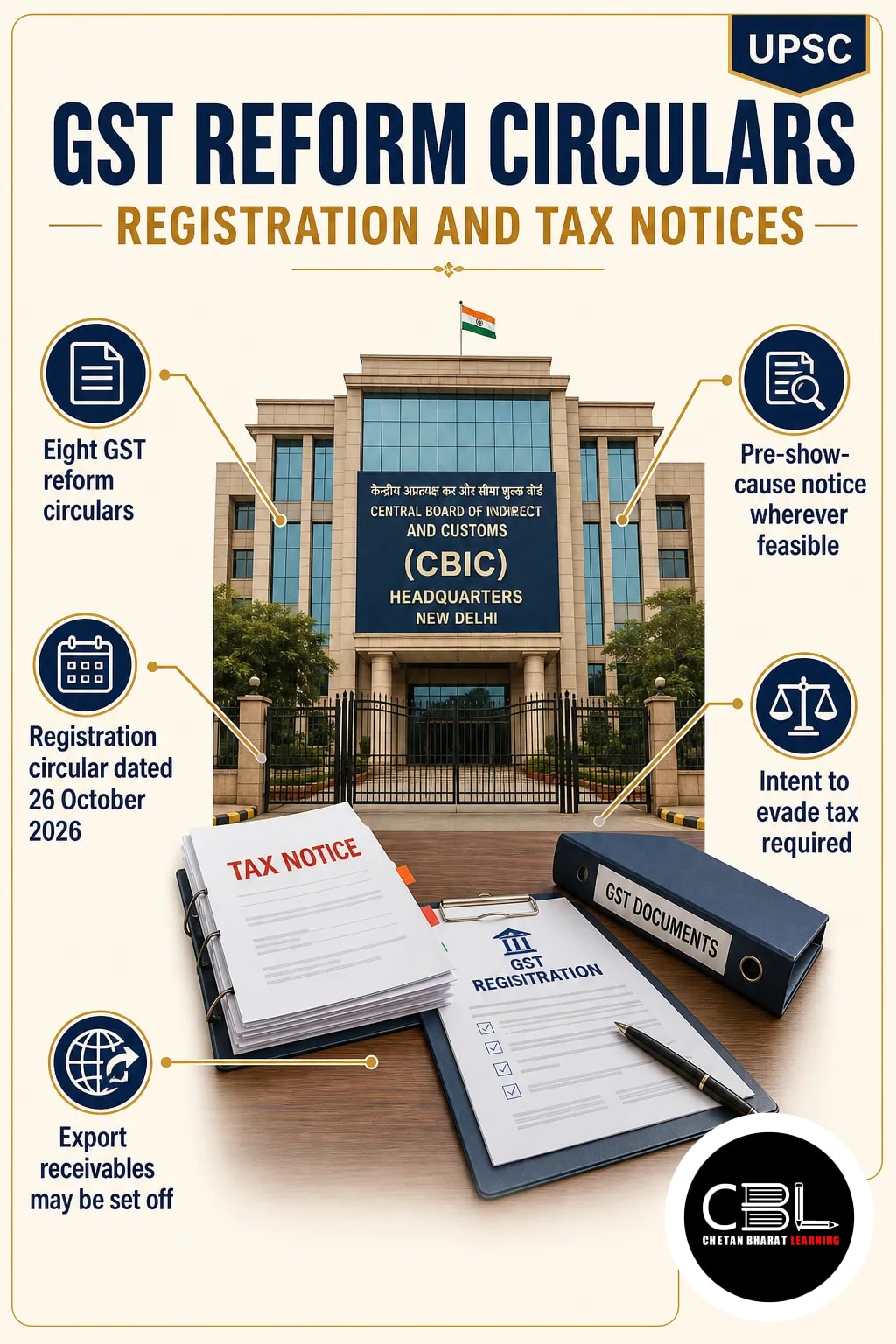
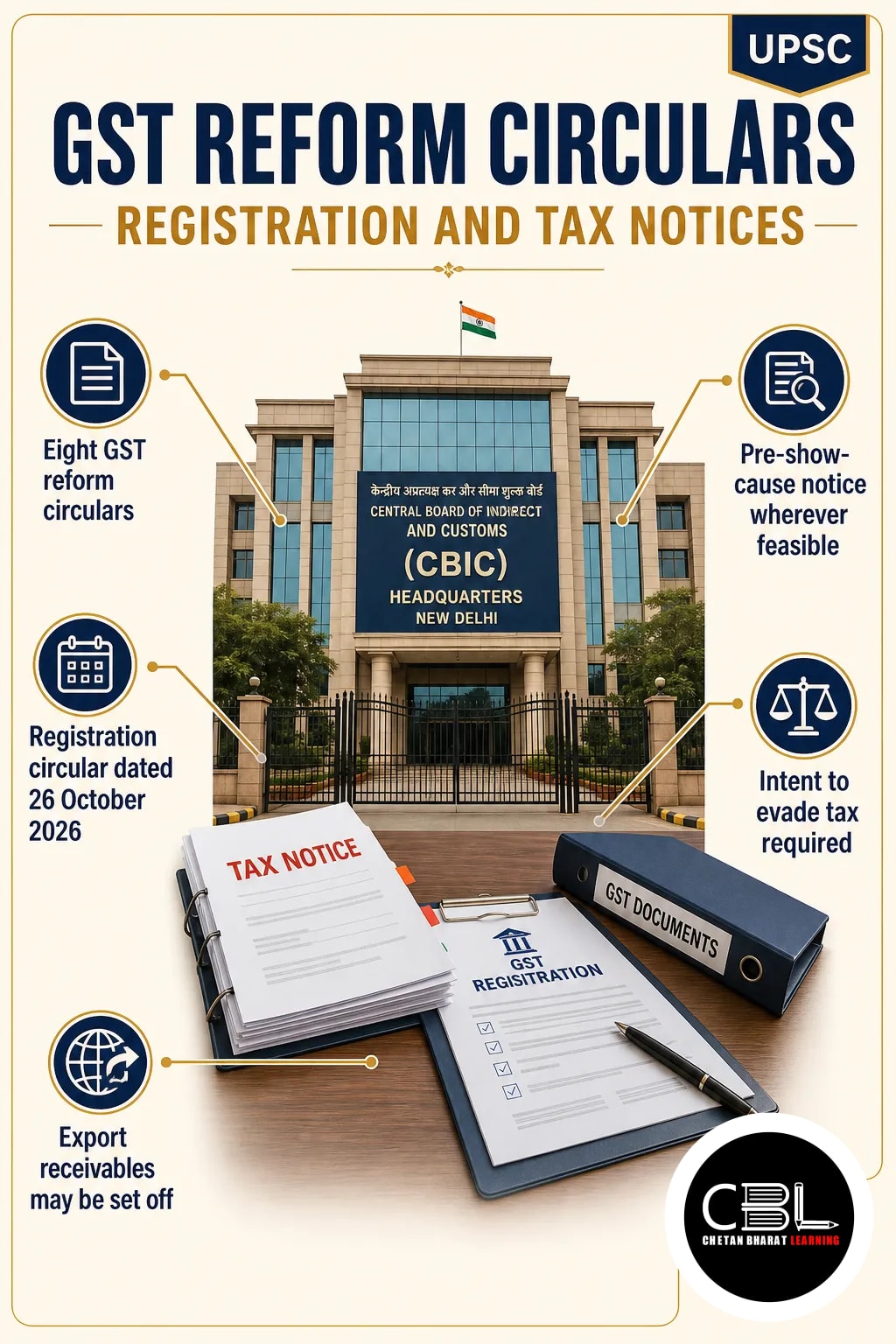
GST reform circulars seek to simplify registration and improve tax notices after the 57th Goods and Services Tax (GST) Council meeting. The measures are relevant to economy and tax administration.
Quick answer: The Central Board of Indirect Taxes and Customs (CBIC) issued eight GST reform circulars after the 57th GST Council meeting in October 2026. They address registration documents, tax demands and export payments. The directions seek to reduce unnecessary queries, improve notice quality and recognise eligible export-import payment set-offs.
What are the GST reform circulars?
The circulars provide administrative guidance on registration, demands and export-payment issues following GST Council decisions. They aim to make procedures more predictable while protecting the tax system from misuse.
The 57th Council meeting also approved process reforms and decriminalisation measures. These included scrapping tax officers’ arrest powers and raising the prosecution threshold from ₹1 crore to ₹5 crore. However, Council approval and implementation of the necessary legal changes are distinct steps.
What changes for GST registration?
CBIC has specified documentation requirements and told officers not to seek irrelevant documents or raise presumptive queries. Its registration circular is dated 26 October 2026.
The board identified missing information, inconsistent details and illegible uploads as causes of delays or rejection. In particular, problems often concern identity details and proof of the principal place of business.
| Issue | Guidance or rule |
|---|---|
| Registered rent or lease agreement | Upload a clear, legible copy of the valid agreement; no other document is required for this purpose. |
| Unregistered rent or lease agreement | Upload the agreement plus one specified recent document in the landlord’s name, such as an electricity bill or property tax receipt. |
| Aadhaar authentication | The source states a seven-day registration timeline for applicants opting for authentication. |
| Other applications | The source states a 30-day processing timeline after physical verification of the business place. |
The article cites aggregate annual turnover thresholds of ₹40 lakh for exclusive goods suppliers and ₹20 lakh for services or mixed supplies. However, registration thresholds have statutory exceptions and conditions; these figures should not be treated as universal.
Registration scrutiny still matters because fraudulent entities may claim or pass on input tax credit (ITC) without an underlying supply. Therefore, the policy challenge is to screen risk without imposing irrelevant demands on genuine applicants. For background, see CBL’s earlier coverage of GST compliance measures.
How should officers handle tax demands?
CBIC calls for clearer notices and a consistent approach to demand, adjudication and appeals. These are quasi-judicial proceedings: officers must apply the law to facts and provide reasons for their decisions.
- Pre-notice opportunity: Officers should issue a pre-show-cause notice wherever feasible. Consequently, taxpayers can clarify their position before formal proceedings.
- Clear allegations: A show-cause notice (SCN) should summarise allegations and state the grounds for proposed action. Thus, the recipient can understand the case to be answered.
- Fraud-related demands: Officers must establish intent to evade tax before invoking stringent provisions concerning fraud, wilful misstatement or suppression of facts.
- Technology and accountability: Officers must independently verify information from artificial intelligence (AI) or other technological tools before relying on it in an adjudication order.
These safeguards can improve voluntary compliance and reduce disputes arising from poorly framed notices. However, a pre-notice is required wherever feasible, not in every case under the circular’s formulation.
How do export payment set-offs qualify?
Eligible export receivables set off against import payables can satisfy the payment-realisation condition for export of services. The set-off must comply with Reserve Bank of India (RBI) directions under the Foreign Exchange Management Act (FEMA).
In that situation, the condition for qualifying as an export of services under the Integrated Goods and Services Tax (IGST) Act is regarded as fulfilled. Therefore, the guidance recognises a permitted settlement method without removing the applicable foreign-exchange requirements.
Why do these reforms matter?
The reforms connect ease of compliance with better-quality enforcement. Their impact will depend on consistent application by field officers and clear communication with taxpayers.
- Business entry: Defined documents can reduce avoidable follow-up queries. Moreover, predictable procedures may help applicants plan registration.
- Revenue protection: Verification remains necessary to detect registrations used for fraudulent ITC. Thus, simplification should not mean abandoning scrutiny.
- Fair adjudication: Specific allegations and evidence of intent distinguish serious fraud claims from routine disagreements. As a result, taxpayers can respond more effectively.
- Digital governance: AI can assist officers, but unchecked outputs may introduce factual errors. Therefore, independent human verification remains essential.
- Trade facilitation: Recognition of compliant set-offs aligns tax administration with a permitted payment arrangement. However, officers must still check the relevant RBI conditions.
What are the challenges and way forward?
The main challenge is translating central guidance into consistent decisions at the field level. Different interpretations, incomplete applications and insufficient verification can each undermine the intended result.
First, tax administrations should train officers on document lists and the distinction between ordinary errors and fraud. Second, standard notice templates should require clear allegations and supporting grounds without replacing case-specific reasoning.
Third, officers should record their independent checks when using AI-generated information. Finally, accessible guidance and feedback on registration queries can help identify recurring procedural problems. These are suggested implementation measures, not additional provisions announced in the circulars.
Source: Indian Express Business, 30 October 2026
- New GST Compliance Measures (11 May 2023)
Asked in UPSC: Previous Year Questions
- UPSC CSE Prelims 2017 (GS Paper I): Which are likely GST advantages: a single market, a lower current account deficit, and an Indian economy larger than China’s?
UPSC also tests the broader economic rationale of GST, so connect administrative changes with the tax’s design.
Punjab PCS and Haryana HCS can test GST registration, tax administration and Centre–state coordination in General Studies. In addition, candidates should connect fair notice procedures with state-level governance and taxpayer services.
Prelims Practice Corner
Mains Practice Questions
Frequently Asked Questions
How many GST reform circulars did CBIC issue?
Eight circulars followed the 57th GST Council meeting. They cover registration, tax demands and export-payment issues, among other reforms.
Is a landlord’s bill always needed for GST registration?
No, because a clear, valid registered rent or lease agreement needs no additional document for the premises. However, an unregistered agreement requires one specified additional document in the landlord’s name.
Can GST officers use AI outputs without verification?
No, because officers must independently verify such information before relying on it in an adjudication order. The circular therefore requires human oversight of technological tools.
Can export receivables be set off against import payables?
Yes, if the set-off complies with RBI directions. In that case, the prescribed realisation condition for export of services under the IGST Act is regarded as fulfilled.
Related Current Affairs
Preparing for UPSC, PCS or HCS?
Talk to a mentor at Chetan Bharat Learning, Chandigarh. Free guidance on choosing the right exam and building a study plan.
Chat on WhatsAppCall 97793 53345UPSC / IAS / PCS coaching in Chandigarh · Trusted by aspirants across Punjab & Haryana
Leave a Reply
You must be logged in to post a comment.