
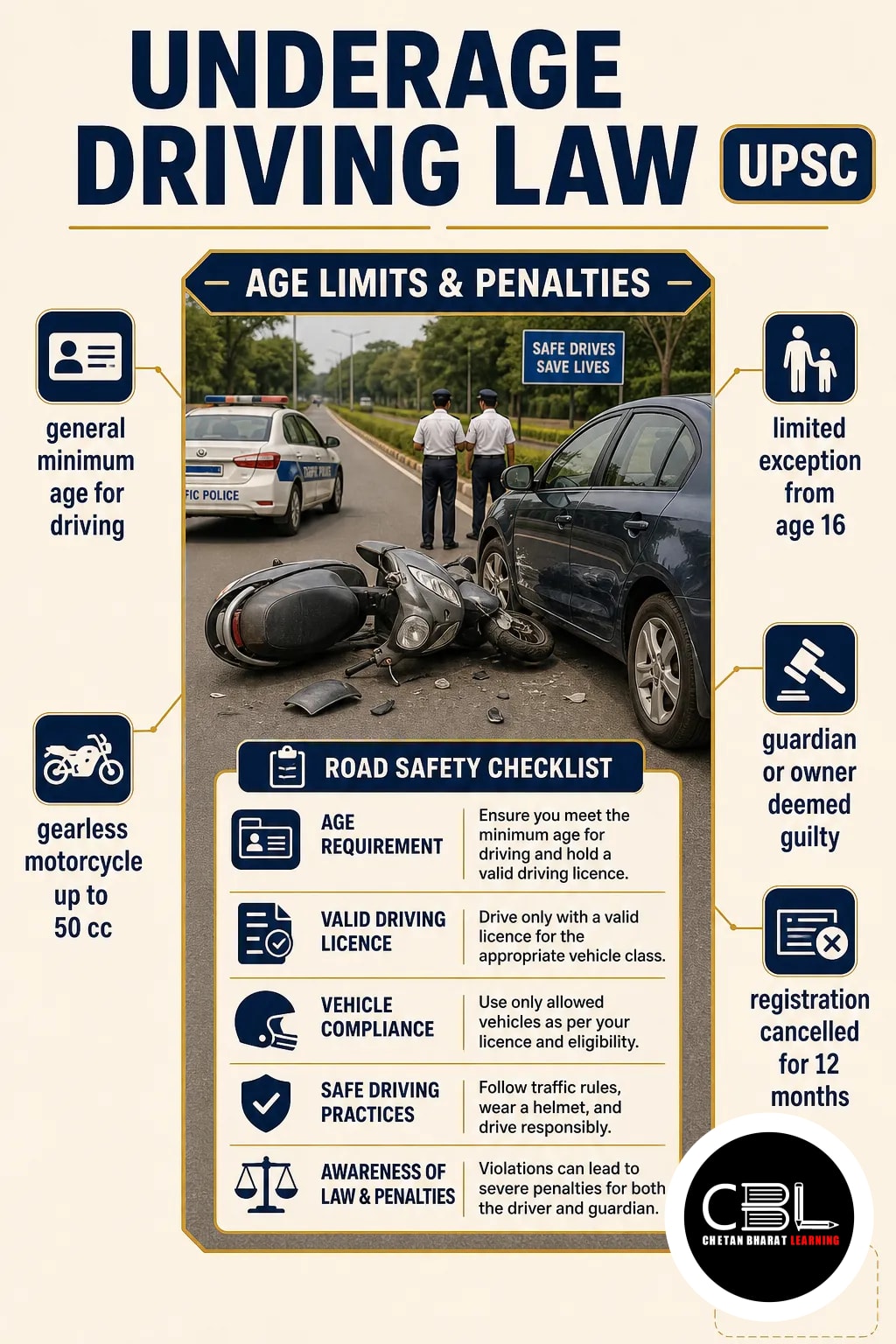

Underage driving law has come into focus after a road accident in Nedumbassery, Kochi, killed three students on a scooter. The incident raises questions about age restrictions under the Motor Vehicles Act, 1988. Explore more polity and law updates.
Quick answer: Underage driving law generally prohibits people below 18 from driving motor vehicles in public places. However, Section 4 of the Motor Vehicles Act permits a person aged 16 or above to drive a gearless motorcycle up to 50 cc, subject to applicable licensing requirements. A fatal accident in Kochi has brought attention to road safety.
Why is underage driving law in the news?
The Hindu discussed the law following a fatal road accident in Nedumbassery, Kochi. Three students travelling on a scooter died in the accident involving a car.
However, the available source text does not establish the car driver’s age. Therefore, the incident itself should not be treated as proof of an underage driving offence.
What are the driving age limits?
Section 4 of the Motor Vehicles Act, 1988 sets the general minimum age at 18 for driving in a public place. However, it creates a narrow exception from age 16.
| Fact | Rule or detail |
|---|---|
| General rule | No person under 18 may drive a motor vehicle in a public place, subject to the exception. |
| Exception | A person aged 16 or above may drive a motorcycle without gear and with engine capacity not exceeding 50 cubic centimetres (cc). |
| Licensing | The age exception does not dispense with applicable licensing requirements. |
| Location | Section 4 addresses driving in a public place. |
For prelims, note the combination of age, vehicle type and engine capacity. Thus, turning 16 does not create a general entitlement to drive a car.
What happens when a juvenile commits a motor vehicle offence?
Section 199A provides consequences when a juvenile commits an offence under the Motor Vehicles Act. It also addresses the responsibility of the guardian or vehicle owner.
- Guardian or owner: The law deems the guardian or owner guilty, subject to specified defences such as lack of knowledge or due diligence.
- Penalty: The prescribed punishment includes imprisonment of up to three years and a fine of ₹25,000.
- Registration: The registering authority cancels the vehicle’s registration for 12 months.
- Licence eligibility: The juvenile who commits the offence cannot obtain a learner’s licence or driving licence until age 25.
In addition, the juvenile is proceeded against under the Juvenile Justice (Care and Protection of Children) Act, 2015. For a separate aspect of road accidents, see the Motor Accident Claims Tribunal process.
Why does the distinction matter?
The age rule and the offence provisions address different questions. First, Section 4 specifies who may drive in a public place; Section 199A then addresses offences committed by juveniles.
Moreover, an accident compensation claim is distinct from determining liability for a driving offence. Therefore, aspirants should not assume that every accident automatically proves an underage driving violation.
Source: The Hindu Explained, 30 October 2026
- Road Accident Claim: MACT Process Explained (26 Sep 2026)
Punjab PCS and Haryana HCS may test driving age limits and juvenile offence provisions in General Studies. In addition, candidates can connect road safety enforcement with state transport administration.
Prelims Practice Corner
Mains Practice Questions
Frequently Asked Questions
What is the minimum driving age in India?
The general minimum is 18 years for driving a motor vehicle in a public place. However, Section 4 permits a limited gearless motorcycle exception from age 16.
Can a 16-year-old drive a motorcycle in India?
Yes, for a gearless motorcycle with engine capacity not exceeding 50 cc. However, applicable licensing requirements must also be met.
What is the penalty for a juvenile driving offence?
Section 199A prescribes up to three years’ imprisonment and a ₹25,000 fine for the guardian or owner, subject to specified defences. In addition, it provides for vehicle registration cancellation and restrictions on the juvenile’s licence eligibility.
Related Current Affairs
Preparing for UPSC, PCS or HCS?
Talk to a mentor at Chetan Bharat Learning, Chandigarh. Free guidance on choosing the right exam and building a study plan.
Chat on WhatsAppCall 97793 53345UPSC / IAS / PCS coaching in Chandigarh · Trusted by aspirants across Punjab & Haryana
Leave a Reply
You must be logged in to post a comment.