
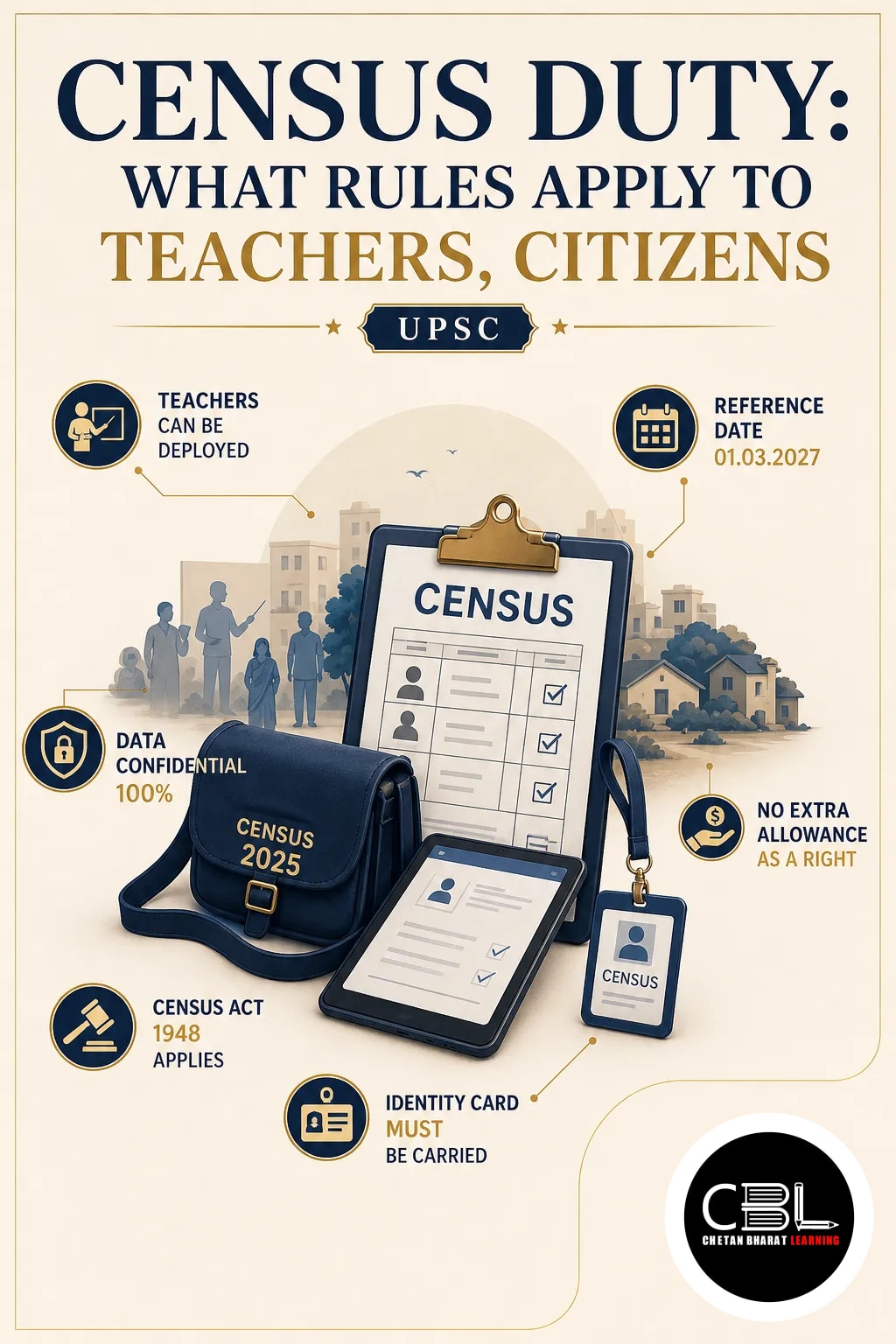
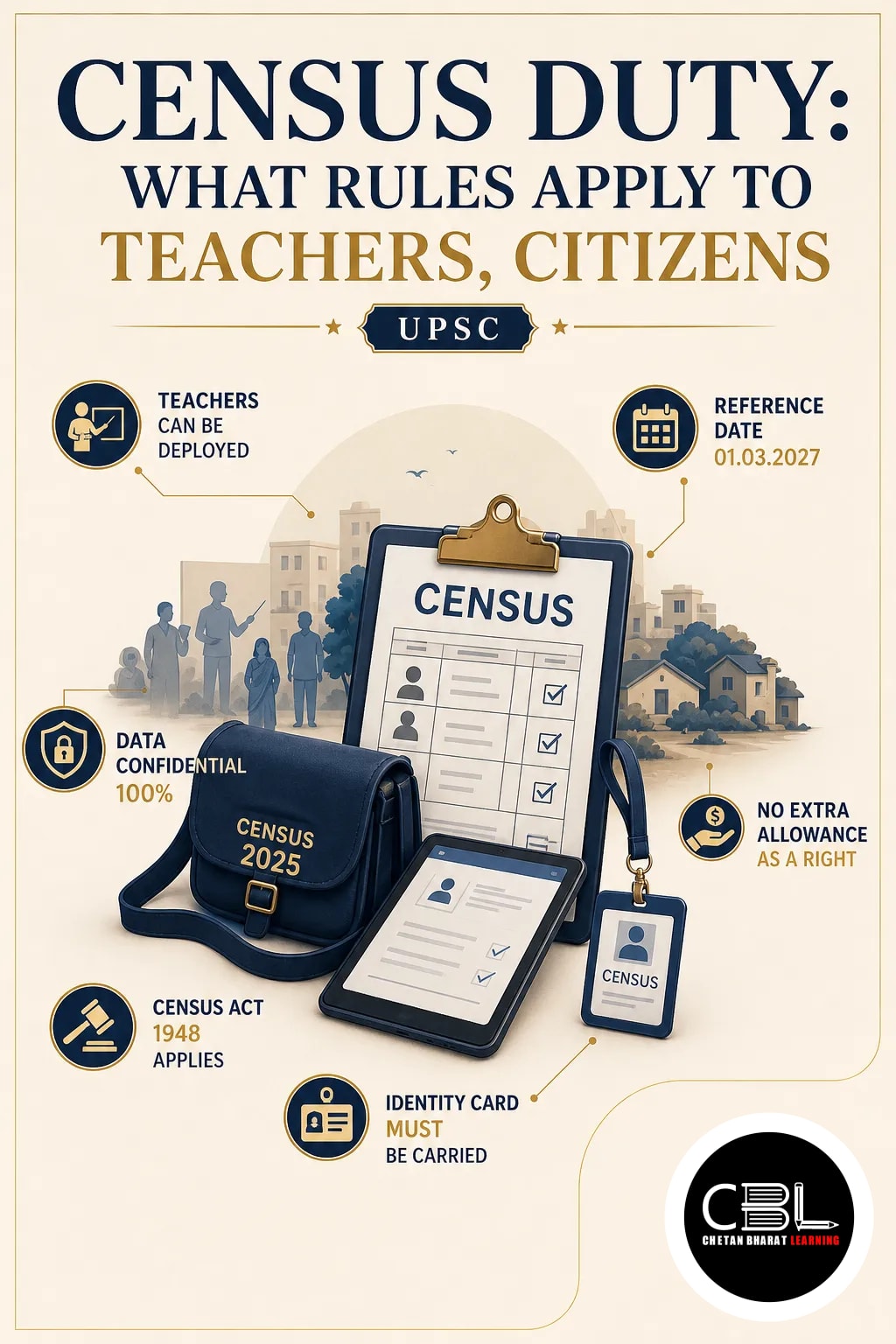
Census duty often raises a practical question: can the State compel private teachers or ordinary citizens to help in enumeration work? For a broader civics context, see CBL current affairs coverage.
What is Census Duty?
The phrase census duty refers to official work assigned for collecting population data during a national census. It usually includes listing households, recording answers, and supporting field-level enumeration.
In India, census work is a sovereign function of the State, so the administration can deploy public personnel for it. The legal question is narrower: whether private teachers or other citizens can be compelled, and under what authority.
That distinction matters because the Constitution protects liberty, but it also permits lawful obligations created by statute. A valid census framework can therefore create limited public duty where the law allows it.
Why in News?
The issue has surfaced around the proposed Census 2027 and the extent to which non-government persons may be drafted into field work. The debate is not about census importance alone, but about the legal boundaries of compulsion.
Explainers like this matter because census operations depend on large human resources. Yet those resources must come from rules that are clear, lawful, and administratively fair.
Key Features
- Statutory census work — Census operations are conducted under legal authority, not informal administrative requests.
- Government staffing preference — Field duties are commonly assigned to public officials, especially those already in the service system.
- Limited compulsory reach — Any compulsion over private persons must flow from law and the purpose stated in that law.
- Data collection function — Census duty is operational, involving counting, verification, and record preparation.
- Public interest basis — The census supports representation, planning, resource allocation, and governance.
Challenges
- Legal clarity — Ambiguity over who can be requisitioned can create disputes and non-compliance.
- Workload pressure — Teachers and other staff may face extra duties alongside core institutional work.
- Training gap — Enumeration needs uniform instructions, and untrained personnel can affect data quality.
- Rights concerns — Compulsion without a clear legal basis may raise constitutional objections.
- Administrative coordination — Census work needs cooperation between central and state machinery, which can be uneven.
Way Forward
The government should rely on a clear legal framework, defined roles, and proper training before assigning enumeration work to any non-government person. Transparent instructions reduce confusion and limit disputes over compulsion.
Where private personnel are needed, the administration should prefer consent-based deployment or narrowly tailored statutory directions. This approach balances census efficiency with constitutional fairness.
A modern census also needs digital support, supervision, and accountability systems. That would reduce dependence on ad hoc manpower arrangements and improve data reliability.
Source: Indian Express Explained, 2026-10-24
Census duty is relevant for state PCS exams under polity, administration, and fundamental rights. It also helps in questions on the relationship between statutory duties, district administration, and service obligations of teachers or public employees.
FAQ
Can private teachers be forced to do census duty?
Only if the law clearly authorises such deployment and the administration follows that framework. The exact answer depends on the statute, the notification, and the scope of assigned work.
Why is census duty considered important?
Census duty supports the collection of population data, which is essential for planning, representation, and welfare delivery. Accurate enumeration strengthens public administration.
What should UPSC aspirants remember about this issue?
Focus on the legal basis of compulsion, constitutional limits, and the administrative purpose of the census. Also connect it with governance, rights, and federal administration.
Related Current Affairs
Preparing for UPSC, PCS or HCS?
Talk to a mentor at Chetan Bharat Learning, Chandigarh. Free guidance on choosing the right exam and building a study plan.
Chat on WhatsAppCall 97793 53345UPSC / IAS / PCS coaching in Chandigarh · Trusted by aspirants across Punjab & Haryana
Leave a Reply
You must be logged in to post a comment.