
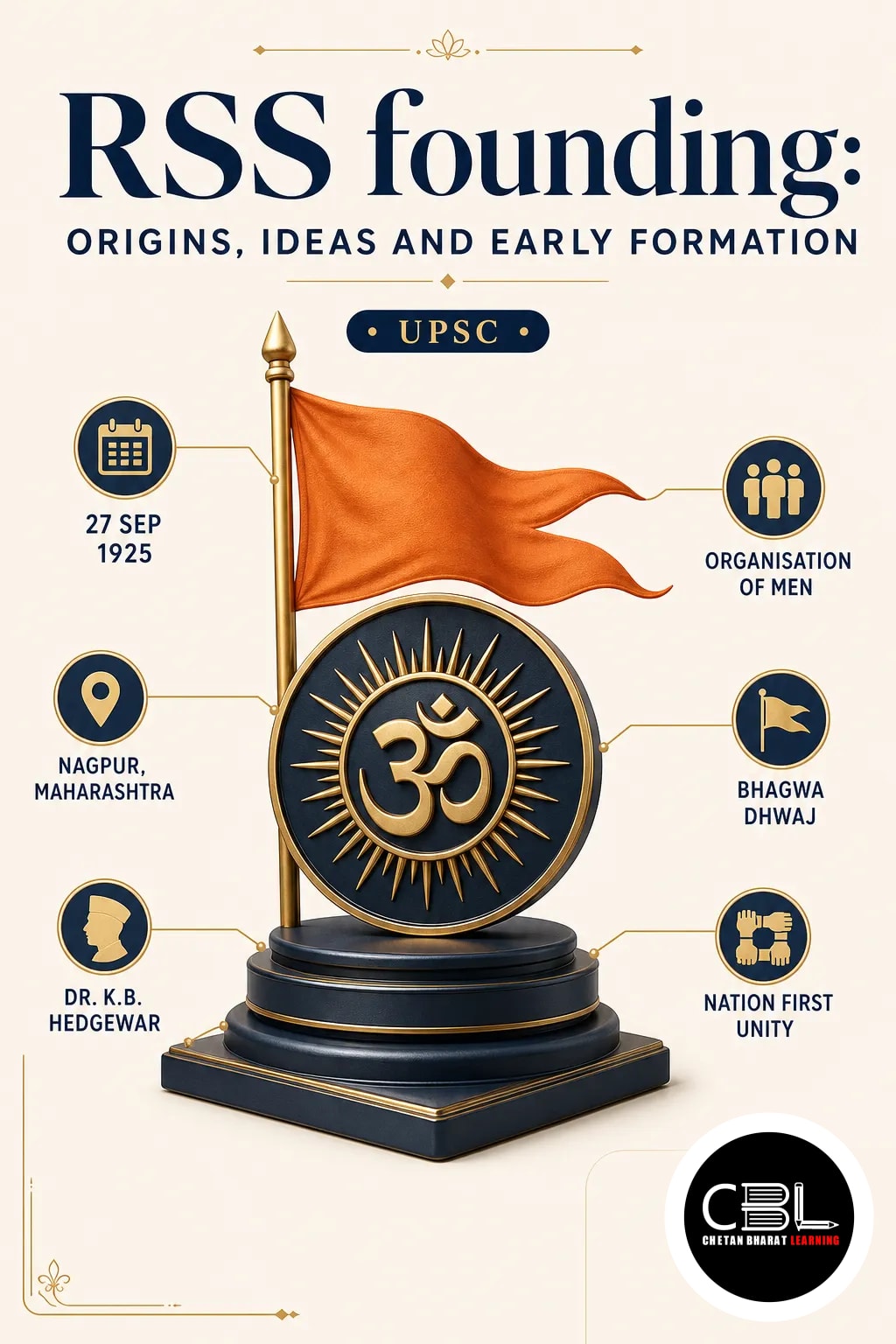

RSS founding is being revisited as an important current affairs theme for understanding how a political organisation took shape in colonial India. The discussion helps link social mobilisation, nationalist politics, and the making of mass organisations.
Who was RSS founder and how was it formed?
The RSS emerged in a period when many Indian public figures were debating identity, discipline, and the role of organised politics. Its early formation reflected the wider churn of late colonial India, where social anxiety, nationalist thought, and community organisation overlapped.
The organisation was built as a structured volunteer network rather than a conventional party. In historical terms, that made its founding distinct from mass electoral platforms and closer to a cadre-based movement.
Why in News?
The article revisits the reasons and process behind RSS founding on the occasion of its 101st year. Such explainers matter because they place present-day debates within their historical setting.
For UPSC preparation, the topic is useful for linking modern history with the evolution of political organisation in India. It also helps in understanding how ideas of social service and cultural nationalism entered public life.
Key Features
- Volunteer-based structure — The RSS began as a disciplined body built around regular drills, meetings, and training.
- Cadre orientation — Its model stressed personal discipline and organisational cohesion over mass membership politics.
- Social and cultural focus — The early organisation emphasised cultural regeneration and community mobilisation.
- Historical context — It took shape against the background of colonial rule, reform movements, and nationalist debate.
Challenges
- Interpretation of origins — Historians often assess the RSS through different lenses, especially political and social history.
- Complex legacy — Its long presence in public life has generated debate over its role and influence.
- Movement versus organisation — The distinction between cultural work and political impact remains central to analysis.
Way Forward
A clear study of RSS founding should use contemporaneous history, not present-day assumptions. UPSC answers should relate the organisation’s early formation to broader themes such as mass politics, social mobilisation, and ideological change.
The topic also shows why modern Indian history cannot be read only through elections or constitutional milestones. Organised civic and political activity shaped the public sphere in parallel ways.
Source: Indian Express Explained, 2026-10-20
This topic can appear under modern Indian history and the study of socio-political organisations. It is also relevant for state PCS questions on social movements, political thought, and the evolution of civil society in India. Candidates should connect such organisations with the wider nationalist context.
FAQ
Why is RSS founding important for UPSC?
It helps explain how organised political and cultural bodies developed in late colonial India. The topic is useful for modern history, political thought, and social mobilisation.
What kind of organisation was the RSS at its origin?
It began as a volunteer-based, disciplined cadre organisation. Its early structure focused on training and cohesion rather than electoral politics.
Which GS paper covers this topic?
It fits best under GS Paper I in the modern Indian history section. It may also support questions on the growth of political and social organisations.
Related Current Affairs
Preparing for UPSC, PCS or HCS?
Talk to a mentor at Chetan Bharat Learning, Chandigarh. Free guidance on choosing the right exam and building a study plan.
Chat on WhatsAppCall 97793 53345UPSC / IAS / PCS coaching in Chandigarh · Trusted by aspirants across Punjab & Haryana
Leave a Reply
You must be logged in to post a comment.