
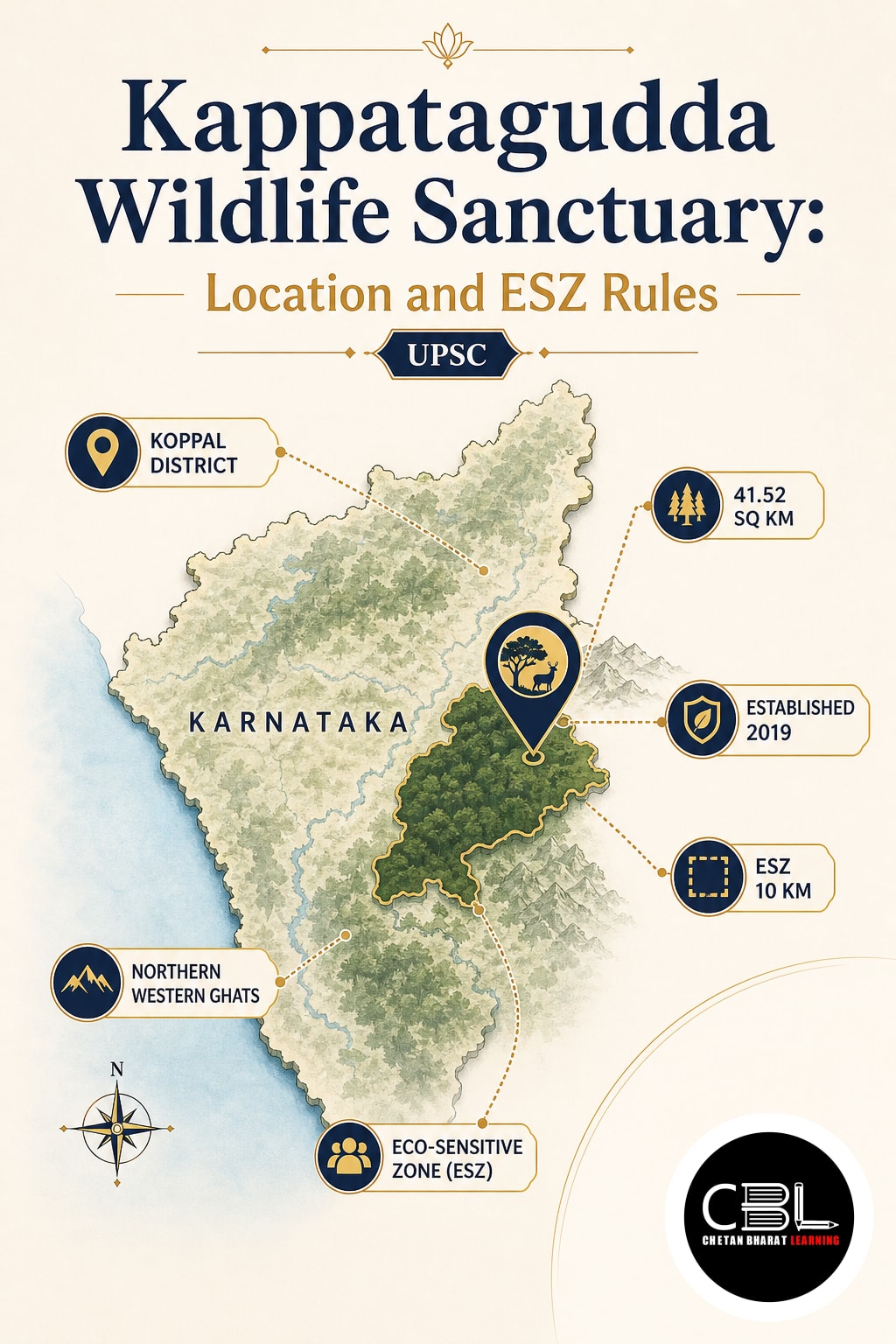

UPSC Mapping
- Prelims: Mapping, Wildlife Sanctuaries and Ecology
- Mains: GS Paper 3 – Environment and Biodiversity Conservation
Article
Kappatagudda Wildlife Sanctuary in Karnataka has attracted attention after the State Board for Wildlife rejected four stone-quarrying proposals near its protected boundary. The proposed sites, located between 422 and 997 metres from the sanctuary, fall within its notified Eco-Sensitive Zone (ESZ). The decision reinforces restrictions on mining near protected habitats and highlights the importance of conserving the dryland biodiversity of northern Karnataka. Explore similar environmental developments in the daily current affairs archive.
Quick Facts
| Location | Sanctuary Area | ESZ Extent | Final ESZ Notification |
|---|---|---|---|
| Gadag, Karnataka | 244.15 sq km | 1–4.30 km | 4 June 2025 |
Location and Key Features
Kappatagudda Wildlife Sanctuary is situated in Gadag district of northern Karnataka, within the Deccan Plateau region. The sanctuary covers approximately 244.15 square kilometres and includes landscapes associated with Gadag, Mundaragi, Shirahatti and Laxmeshwar taluks.
Locally, the hill range is sometimes called the Western Ghats of North Karnataka because of its biological richness. This nickname does not mean that the sanctuary forms part of the Western Ghats mountain system.
The protected area contains dry grasslands, scrub forests, medicinal plants and wildlife adapted to relatively dry climatic conditions. It also serves an important watershed function in the wider Tungabhadra River basin.
Important Geographical Facts
| Feature | Details |
|---|---|
| State | Karnataka |
| District | Gadag |
| Physiographic Region | Deccan Plateau |
| Wildlife Sanctuary Notification | May 2019 |
| Sanctuary Area | 244.15 sq km |
| Notified ESZ Area | 322.695 sq km |
| ESZ Boundary Extent | 1–4.30 km, varying by direction |
| Major Ecosystems | Dry grasslands, scrub forests and dry deciduous vegetation |
| River Basin | Tungabhadra basin |
Note: The final Union government ESZ notification specifies 322.695 sq km, rather than the 423.7 sq km figure appearing in some secondary summaries. The final gazette is used here for the notified boundary and area.
Historical Background
- 2015: Parts of the Kappatagudda landscape received conservation reserve recognition, reflecting concern about its biodiversity.
- 2017: The conservation status became a major public issue following objections to denotification and mining-related pressures.
- May 2019: Karnataka notified approximately 244.15 sq km as Kappatagudda Wildlife Sanctuary.
- June 2025: The Union environment ministry finalised the sanctuary’s Eco-Sensitive Zone notification.
- October 2026: The State Board for Wildlife rejected four quarrying proposals near the sanctuary.
Why in News?
The Karnataka State Board for Wildlife rejected four proposed stone-quarrying operations near Kappatagudda Wildlife Sanctuary. The proposed sites were located in Magadi and Parasapura villages of Gadag district and covered approximately 3.2 hectares. Their distances from the sanctuary boundary ranged from 422 to 997 metres, placing them inside the notified ESZ.
The board’s decision followed forest department assessments and applicable restrictions on mining close to protected habitats. The decision reflects growing scrutiny of industrial activities around ecologically sensitive areas. News source: Times of India report, 11 October 2026.
What are Eco-Sensitive Zones?
An Eco-Sensitive Zone is an area notified around a protected landscape to help minimise the harmful effects of surrounding human activities. It acts as a regulated transition area between ecologically important habitats and areas with more intensive development.
The Central Government notifies ESZs under the Environment (Protection) Act, 1986. ESZ regulations classify activities as prohibited, regulated or permitted, depending on the relevant notification, applicable laws and judicial directions.
Key Features of Kappatagudda’s ESZ
- Final notification: S.O. 2485(E), dated 4 June 2025.
- Variable boundary: Extends between 1 and 4.30 kilometres from the sanctuary boundary, depending on direction.
- Notified area: Approximately 322.695 square kilometres.
- Village coverage: Includes 62 villages within the defined zone.
- Mining restrictions: Commercial mining, quarrying and crushing activities face prohibitions.
- Ecological management: Aims to protect forests, wildlife habitats, water resources and landscape integrity.
Ecological Significance
1. Rich Medicinal Plant Diversity
The Kappatagudda hill landscape contains hundreds of medicinal and aromatic plant varieties. Its botanical richness has given rise to associations with Sanjeevini Parvata in local tradition. The sanctuary protects important plant habitats in a region where dry climate and surrounding development can place pressure on natural vegetation.
2. Conservation of Dryland Wildlife
The sanctuary supports species associated with grassland, scrubland and open woodland ecosystems.
- Carnivores: Indian grey wolf, leopard, striped hyena and golden jackal.
- Herbivores: Blackbuck, four-horned antelope and chinkara.
- Other fauna: Bengal fox, grey langur and several reptiles.
- Avifauna: Indian peafowl, waterbirds and several resident and migratory bird species.
3. Watershed and Groundwater Recharge
Kappatagudda forms part of a regional watershed supporting drainage towards the Tungabhadra River basin. Natural vegetation helps slow surface runoff and supports soil moisture conservation, reducing soil erosion and maintaining hydrological functions in drought-prone northern Karnataka.
4. Geological Significance
The region contains important geological formations associated with the Deccan Plateau, including ancient schist formations and mineral-bearing rocks. Its geological resources have attracted mining interest, making conservation planning particularly important for preserving the landscape’s ecological value.
5. Regional Climate Regulation
Grassland and scrub vegetation supports soil stability, local biodiversity and ecosystem resilience. The hill landscape provides ecological continuity in an otherwise intensively used region, contributing to wildlife protection and long-term environmental security for nearby communities.
Threats to the Sanctuary
- Mining and quarrying: Excavation, blasting and stone crushing that damage habitats and generate dust and noise.
- Habitat fragmentation: Roads, industrial activity and land conversion obstruct wildlife movement.
- Vegetation degradation: Unsustainable extraction, grazing pressure and disturbance reduce native plant diversity.
- Groundwater impacts: Quarrying may alter drainage conditions and increase risks to soil and water resources.
- Human-wildlife conflict: Habitat disturbance can increase interactions between wild animals and settlements.
- Enforcement challenges: Monitoring unauthorised extraction across an extensive landscape requires sustained administrative capacity.
Conservation and Policy Measures
- Enforce ESZ restrictions: Prevent prohibited mining and quarrying within notified eco-sensitive boundaries.
- Strengthen monitoring: Use geospatial mapping, field inspections and interdepartmental coordination to identify unauthorised activities.
- Protect medicinal flora: Promote conservation, ecological research and restoration of degraded plant habitats.
- Support local communities: Encourage sustainable livelihoods and community participation in habitat protection.
- Preserve watershed functions: Restore vegetation in erosion-prone areas and protect natural drainage channels.
- Improve environmental appraisal: Evaluate cumulative ecological impacts rather than examining each proposed project in isolation.
- Promote landscape-level conservation: Protect grasslands, scrub forests and wildlife movement routes beyond the immediate sanctuary boundary.
The rejection of quarrying proposals demonstrates the importance of applying environmental safeguards before irreversible landscape damage occurs. Effective conservation must combine scientifically defined boundaries, consistent enforcement and cooperation with local communities. Kappatagudda Wildlife Sanctuary illustrates why dryland ecosystems deserve protection alongside forests and wetlands. Its biodiversity, medicinal flora and watershed functions make it an important conservation landscape in northern Karnataka.
For related environmental topics, visit the current affairs analysis portal. Additional information on protected-area conservation is available through the Wildlife Institute of India.
Prelims Practice Corner
Q1. Kappatagudda Wildlife Sanctuary is located in which district of Karnataka?
- (a) Kodagu
- (b) Shivamogga
- (c) Gadag
- (d) Mysuru
Answer: (c) Gadag district in northern Karnataka.
Q2. Consider the following statements about Kappatagudda Wildlife Sanctuary:
1. It lies within the Deccan Plateau region.
2. It is commonly called the Western Ghats of North Karnataka.
3. It is officially located within the Western Ghats mountain chain.
Which statements are correct?
- (a) 1 and 2 only
- (b) 2 and 3 only
- (c) 1 and 3 only
- (d) 1, 2 and 3
Answer: (a) Statements 1 and 2 are correct.
Q3. Eco-Sensitive Zones around wildlife sanctuaries are notified primarily under which legislation?
- (a) Indian Forest Act, 1927
- (b) Biological Diversity Act, 2002
- (c) Forest Rights Act, 2006
- (d) Environment (Protection) Act, 1986
Answer: (d) Environment (Protection) Act, 1986.
Q4. The Kappatagudda Wildlife Sanctuary forms part of the catchment associated with which river basin?
- (a) Mahanadi
- (b) Tungabhadra
- (c) Narmada
- (d) Periyar
Answer: (b) Tungabhadra basin.
Q5. Consider the following statements regarding Eco-Sensitive Zones:
1. They may regulate industrial and development activities around protected areas.
2. Their boundaries are always exactly one kilometre wide.
3. Their notifications may distinguish prohibited, regulated and permitted activities.
Which statements are correct?
- (a) 1 only
- (b) 2 and 3 only
- (c) 1 and 3 only
- (d) 1, 2 and 3
Answer: (c) Statements 1 and 3 are correct.
Mains Practice Questions
Q1. Eco-Sensitive Zones serve as important regulatory buffers around protected areas. Discuss their ecological significance and examine the challenges associated with regulating mining and other development activities near wildlife sanctuaries. (15 marks)
Answer Structure:
- Intro: Define Eco-Sensitive Zones and explain their legal foundation under the Environment (Protection) Act, 1986.
- Body: Discuss habitat protection, restrictions on mining, ecological connectivity, local livelihoods, enforcement challenges and environmental appraisal.
- Conclusion: Recommend science-based zoning, consistent enforcement and community-led conservation.
Q2. Dry grasslands and scrub forests are frequently undervalued despite their significant contribution to biodiversity and ecosystem services. Examine with reference to Kappatagudda Wildlife Sanctuary. (10 marks)
Answer Structure:
- Intro: Introduce the ecological importance of semi-arid grassland and scrub ecosystems.
- Body: Explain medicinal flora, dryland wildlife, soil conservation, watershed functions and pressures from mining and habitat conversion.
- Conclusion: Emphasise landscape-level habitat protection and recognition of grasslands as valuable natural ecosystems.
Frequently Asked Questions
Where is Kappatagudda Wildlife Sanctuary located?
It is located in Gadag district of northern Karnataka, in the Deccan Plateau region. The sanctuary protects dry grasslands, scrub forests, medicinal plants and several wildlife species.
Why was Kappatagudda Wildlife Sanctuary in the news in 2026?
The Karnataka State Board for Wildlife rejected four stone-quarrying proposals located between 422 and 997 metres from the sanctuary boundary. The sites fell within the notified Eco-Sensitive Zone, where mining restrictions apply.
What is special about Kappatagudda Wildlife Sanctuary?
The sanctuary is known for medicinal plant diversity, Indian grey wolves, blackbucks and other dryland wildlife. It also supports watershed functions and is popularly called the Western Ghats of North Karnataka because of its ecological richness.
Related Current Affairs
Preparing for UPSC, PCS or HCS?
Talk to a mentor at Chetan Bharat Learning, Chandigarh. Free guidance on choosing the right exam and building a study plan.
Chat on WhatsAppCall 97793 53345UPSC / IAS / PCS coaching in Chandigarh · Trusted by aspirants across Punjab & Haryana
Leave a Reply
You must be logged in to post a comment.