
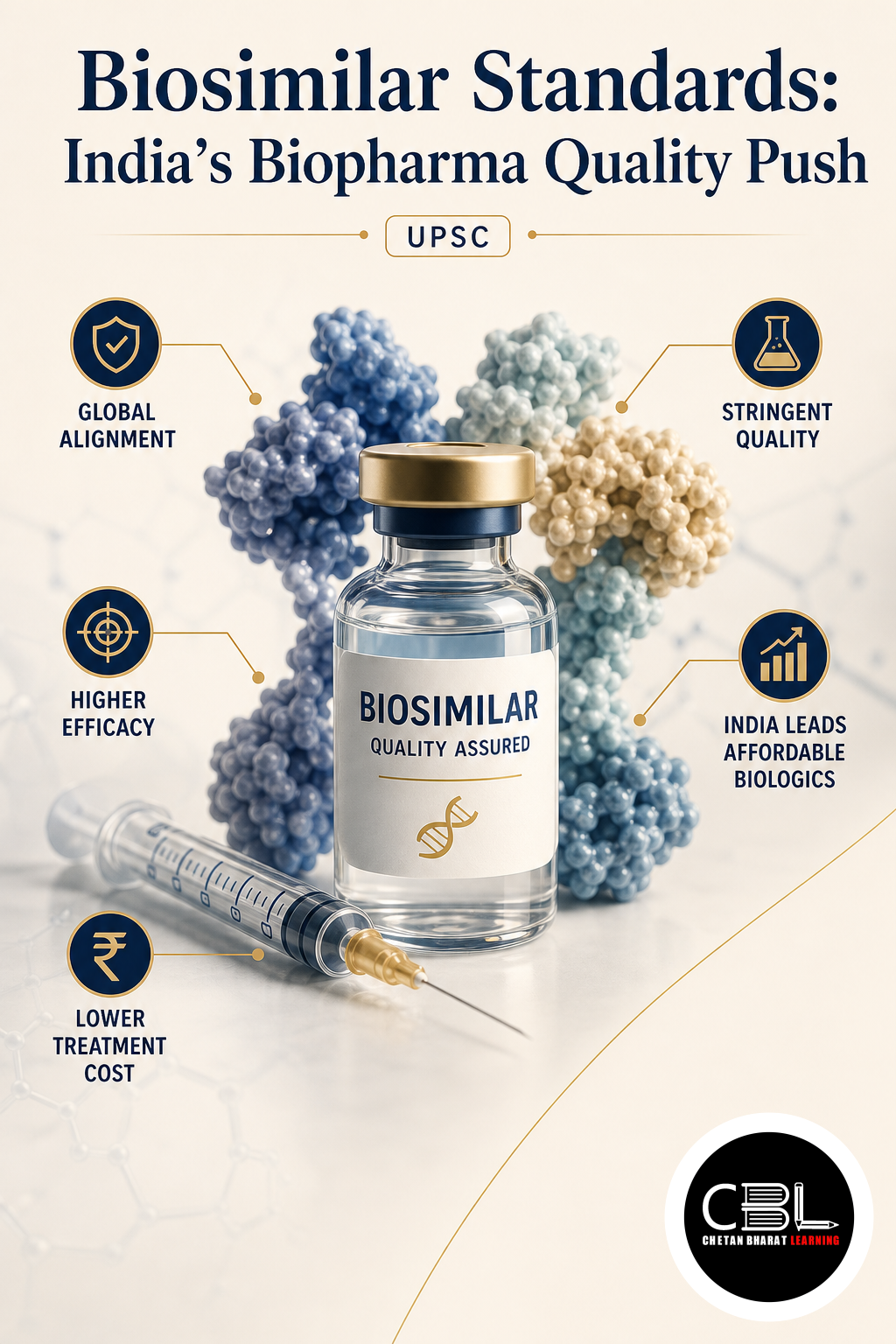
UPSC Mapping
| Prelims | Indian Pharmacopoeia Commission, Biosimilars and Drug Standards |
|---|---|
| Mains | GS Papers II and III — Health and Biotechnology |
What are Biosimilar Standards?
Biosimilar Standards establish the scientific requirements for evaluating medicines developed against approved biological products. A biosimilar must remain highly similar to its reference medicine in quality, safety and efficacy. Regulators must also find no clinically meaningful differences between the two products.
Biological medicines contain complex molecules produced through living cells or biological processes. Their structure and manufacturing sensitivity prevent companies from making exact copies like conventional chemical generics. Regulators therefore require a stepwise comparability exercise involving analytical characterisation, functional testing, clinical evidence and immunogenicity assessment.
Why are Biosimilar Standards in News?
Biosimilar Standards gained attention after the Indian Pharmacopoeia Commission organised a national conference in Bengaluru. The two-day event on 10–11 September 2026 examined quality, safety, regulation and domestic development. It brought together regulators, industry representatives, academics and researchers for coordinated discussion.
The conference supported India’s Biopharma SHAKTI vision and its ambition to strengthen advanced pharmaceutical manufacturing. IPC also released an Indian Pharmacopoeia Reference Substance for Enoxaparin Sodium bioassays. This authenticated material can improve the accuracy and consistency of biological activity testing, as outlined in the official PIB release.
Key Features
A reliable regulatory system evaluates the complete product rather than relying on a single clinical test.
- Reference-product comparison: Developers compare the proposed medicine with an already approved biologic using sensitive scientific methods that can identify even small structural, functional or purity differences.
- Analytical characterisation: Laboratories examine molecular structure, biological activity, impurities, stability and manufacturing consistency because these attributes can influence therapeutic performance and patient safety.
- Stepwise evidence: Regulators begin with extensive laboratory comparisons and seek additional non-clinical or clinical evidence when unresolved uncertainty could affect safety, effectiveness or immune responses.
- Reference substances: Authenticated materials help laboratories calibrate methods, compare results and maintain consistency across manufacturers, testing facilities and successive batches of complex biological products.
- Post-market surveillance: Manufacturers and regulators must monitor adverse events after approval because wider patient use may reveal rare reactions not detected during development.
Challenges
India must combine affordable access with rigorous scientific oversight throughout each product’s life cycle.
- Manufacturing complexity: Small changes in cell lines, raw materials, equipment or production conditions can alter a biologic’s attributes, requiring strong process control and repeated comparability testing.
- Regulatory capacity: Authorities need trained evaluators, specialised laboratories and updated guidance to assess rapidly evolving technologies without weakening evidence requirements or delaying beneficial products unnecessarily.
- Pharmacovigilance gaps: Weak adverse-event reporting and incomplete product identification can obstruct traceability, especially when several manufacturers market products linked to one reference medicine.
- Stakeholder confidence: Doctors and patients may misunderstand similarity, substitution and interchangeability, creating either unjustified distrust or unsafe assumptions that every product can be switched automatically.
- Access and competition: High development costs, intellectual-property questions and uneven market uptake can limit price reductions despite domestic capability, an issue connected with wider health and science analysis.
Way Forward
Strong Biosimilar Standards require investment in reference materials, advanced laboratories and specialised regulatory skills. India should regularly update product-specific guidance and strengthen coordination among CDSCO, IPC, research institutions and manufacturers. Transparent scientific consultations can reduce uncertainty while preserving demanding approval thresholds.
Authorities should build interoperable pharmacovigilance systems that record brand names, manufacturers and batch details. Training for clinicians and clear public communication can improve confidence without presenting these medicines as identical generics. The Indian Pharmacopoeia Commission can deepen international cooperation while developing domestic reference substances and harmonised testing practices.
Prelims Practice Corner
Q1. Which statement best describes a biosimilar?
(a) An exact chemical copy of any patented drug (b) A biological product highly similar to an approved reference medicine (c) A traditional medicine produced from plants (d) A vaccine without regulatory approval
Answer: (b) It must show high similarity and no clinically meaningful differences from the reference product.
Q2. The Indian Pharmacopoeia Commission functions under which Union ministry?
(a) Ministry of Chemicals and Fertilizers (b) Ministry of Science and Technology (c) Ministry of Health and Family Welfare (d) Ministry of Commerce and Industry
Answer: (c) IPC is an autonomous institution under the Ministry of Health and Family Welfare.
Q3. What is the primary purpose of an Indian Pharmacopoeia Reference Substance?
(a) Fixing retail medicine prices (b) Providing authenticated material for quality testing (c) Granting pharmaceutical patents (d) Approving hospital construction
Answer: (b) It provides an authenticated benchmark for accurate and consistent laboratory testing.
Q4. Why are biosimilars not treated as exact copies of reference biologics?
(a) Biological products are complex and manufactured through living systems (b) They contain no active ingredient (c) India prohibits their comparison (d) They require no quality evaluation
Answer: (a) Natural variability and manufacturing complexity prevent exact replication like conventional chemical generics.
Q5. Post-market pharmacovigilance for biological medicines primarily helps regulators to:
(a) Eliminate all clinical studies (b) Monitor adverse events during wider patient use (c) Replace quality-control laboratories (d) Determine customs duties
Answer: (b) Continued surveillance can identify rare or delayed safety concerns after market approval.
Mains Practice Questions
Q1. Explain how a strong regulatory framework for biosimilars can balance patient safety with affordable access to biological medicines. (15 marks)
Answer Structure:
- Intro: Define biosimilars and distinguish them from conventional chemical generics.
- Body: Discuss analytical comparability, clinical evidence, immunogenicity, manufacturing control, pharmacovigilance, competition and affordability.
- Conclusion: Link credible regulation with public confidence, domestic innovation and equitable healthcare access.
Q2. Examine India’s opportunities and institutional challenges in becoming a global hub for biopharmaceutical manufacturing. (15 marks)
Answer Structure:
- Intro: Place biological medicines within India’s pharmaceutical and biotechnology ambitions.
- Body: Cover skilled manpower, research capacity, manufacturing scale, regulatory expertise, reference materials, clinical infrastructure and global harmonisation.
- Conclusion: Recommend coordinated investment in science, regulation and patient-centred safety systems.
FAQs on Biosimilar Standards
What do Biosimilar Standards require?
They require extensive comparison with an approved reference biologic. Developers must address quality attributes, biological activity, safety, efficacy and possible immune responses.
How are biosimilars different from generic medicines?
Generic medicines usually replicate relatively simple chemical molecules. Biosimilars involve complex biological products, so regulators assess high similarity instead of demanding molecular identity.
What role does the Indian Pharmacopoeia Commission perform?
IPC develops and updates official medicine-quality specifications through the Indian Pharmacopoeia. It also supplies reference substances and supports pharmacovigilance and pharmaceutical quality infrastructure.
Related Current Affairs
Preparing for UPSC, PCS or HCS?
Talk to a mentor at Chetan Bharat Learning, Chandigarh. Free guidance on choosing the right exam and building a study plan.
Chat on WhatsAppCall 97793 53345UPSC / IAS / PCS coaching in Chandigarh · Trusted by aspirants across Punjab & Haryana
Leave a Reply
You must be logged in to post a comment.