
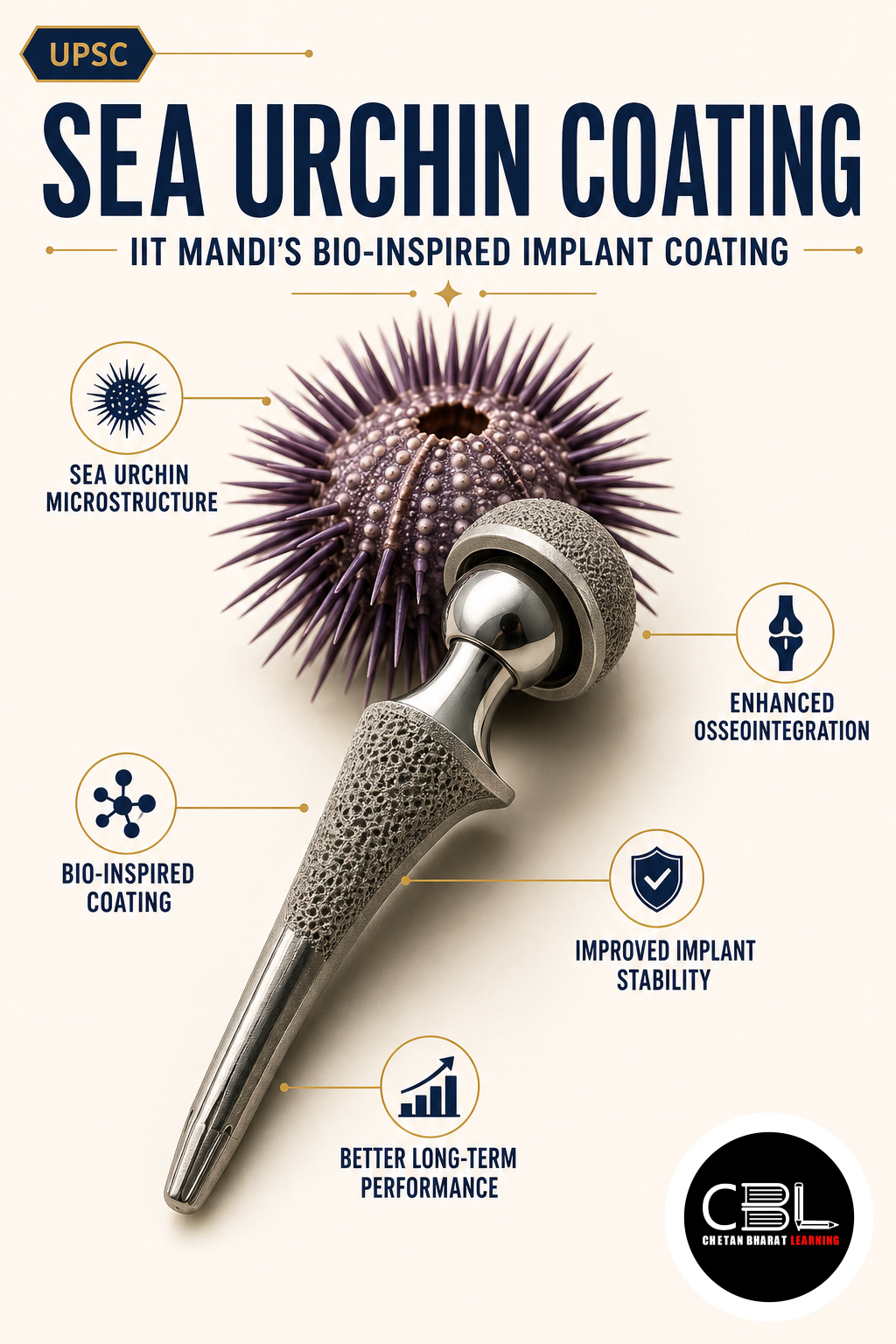

Sea Urchin Coating is a bio-inspired innovation developed by IIT Mandi, using tiny hydroxyapatite structures on biodegradable 3D-printed plastic scaffolds. The coating mechanically disrupts bacteria while promoting better bone integration, addressing issues of infection and poor implant integration. For more such science and technology updates, explore the science and technology archive.
| Important for | |
|---|---|
| Prelims | Science & Technology |
| Mains | GS Paper 3 (Science & Technology) |
| Inspiration | Material |
|---|---|
| Sea urchins | Hydroxyapatite |
What is Sea Urchin Coating?
Sea Urchin Coating is a bio-inspired coating developed by IIT Mandi researchers using tiny hydroxyapatite structures on biodegradable 3D-printed plastic scaffolds. The design is inspired by sea urchins, marine invertebrates of the phylum Echinodermata. The coating mechanically disrupts bacteria while promoting better bone integration, addressing two major challenges in medical implants: infection and poor implant integration.
Sea urchins are spherical animals with a shell of close-fitting limy plates and spines that protect them from predators. They inhabit intertidal zones and shallow reefs; some tropical species possess venomous spines. The European Edible Sea Urchin is listed as Near Threatened on the IUCN Red List.
Why is Sea Urchin Coating in News?
IIT Mandi has developed this bio-inspired coating that offers dual benefits: antibacterial action and enhanced bone integration. It addresses implant infection and failure in orthopaedics and dentistry. The use of hydroxyapatite—a biocompatible calcium phosphate—promotes bone growth, while mechanical disruption of bacteria reduces infection risk without antibiotics. For details, see the PIB release.
Key Features of Sea Urchin Coating
- Bio-Inspired Design: Mimics the structure of sea urchin spines.
- Antibacterial Action: Mechanically disrupts bacteria without antibiotics.
- Bone Integration: Hydroxyapatite promotes bone growth and implant fixation.
- Biodegradable Scaffold: 3D-printed plastic scaffold degrades over time.
- Dual Benefit: Addresses both infection and poor integration.
Challenges in Sea Urchin Coating
- Scalability: Translating lab-scale innovation to commercial production.
- Regulatory Approval: Clinical trials and regulatory clearance required.
- Cost: Ensuring the coating process is cost-effective for widespread use.
- Long-Term Stability: Maintaining coating effectiveness over time.
- Material Compatibility: Working with various implant materials.
Way Forward for Sea Urchin Coating
To bring Sea Urchin Coating to clinical use, IIT Mandi should collaborate with industry partners for scale-up and clinical trials. Securing funding from government and private sources can accelerate development. Streamlining regulatory pathways for bio-inspired medical devices is essential.
Further research on long-term performance and biocompatibility in animal models is needed. The technology has potential applications beyond orthopaedics, including dental implants and cardiovascular devices. Refer to the FDA for international best practices.
Prelims Practice Corner
Q1. Which marine invertebrate inspired the coating developed by IIT Mandi?
(a) Starfish (b) Sea urchin (c) Sea cucumber (d) Coral
Answer: (b) Sea urchin
Q2. What material is used in the coating?
(a) Titanium (b) Hydroxyapatite (c) Silicone (d) Polymer
Answer: (b) Hydroxyapatite
Q3. What is the dual benefit of the coating?
(a) Antibacterial and bone integration (b) Antibacterial and anti-inflammatory (c) Bone integration and anti-inflammatory (d) Antibacterial and anti-cancer
Answer: (a) Antibacterial and bone integration
Q4. What is the IUCN status of the European Edible Sea Urchin?
(a) Least Concern (b) Near Threatened (c) Vulnerable (d) Endangered
Answer: (b) Near Threatened
Q5. What is the primary role of the coating’s antibacterial action?
(a) Killing bacteria with chemicals (b) Mechanically disrupting bacteria (c) Preventing bacterial adhesion (d) Releasing antibiotics
Answer: (b) Mechanically disrupting bacteria
Mains Practice Questions
Q1. Discuss the significance of bio-inspired technologies in healthcare, with reference to the sea urchin-inspired coating developed by IIT Mandi. (250 words, 15 marks)
Intro: Introduce bio-inspired design and the sea urchin coating.
Body: Explain the technology, its dual benefit (antibacterial and bone integration), and its potential impact on implant success. Discuss challenges and the need for clinical translation.
Conclusion: Emphasize the potential of biomimetics in medical innovation.
Q2. What is the role of hydroxyapatite in bone tissue engineering? (150 words, 10 marks)
Intro: Define hydroxyapatite.
Body: Explain that hydroxyapatite is a calcium phosphate mineral similar to bone mineral. It promotes bone growth and osseointegration, making it ideal for coatings and scaffolds.
Conclusion: Conclude that hydroxyapatite is key to bone regeneration.
FAQs on Sea Urchin Coating
What is sea urchin coating?
It is a bio-inspired coating for medical implants that disrupts bacteria and promotes bone integration.
Which institute developed this technology?
IIT Mandi developed the coating.
What are the benefits of this coating?
It reduces infection risk and improves implant fixation, addressing two major clinical challenges.
Related Current Affairs
Preparing for UPSC, PCS or HCS?
Talk to a mentor at Chetan Bharat Learning, Chandigarh. Free guidance on choosing the right exam and building a study plan.
Chat on WhatsAppCall 97793 53345UPSC / IAS / PCS coaching in Chandigarh · Trusted by aspirants across Punjab & Haryana
Leave a Reply
You must be logged in to post a comment.