
UPSC Syllabus Mapping
GS Paper
GS-II
Subject
Health, Social Sector and Public Health
What is Cyclospora Parasite?
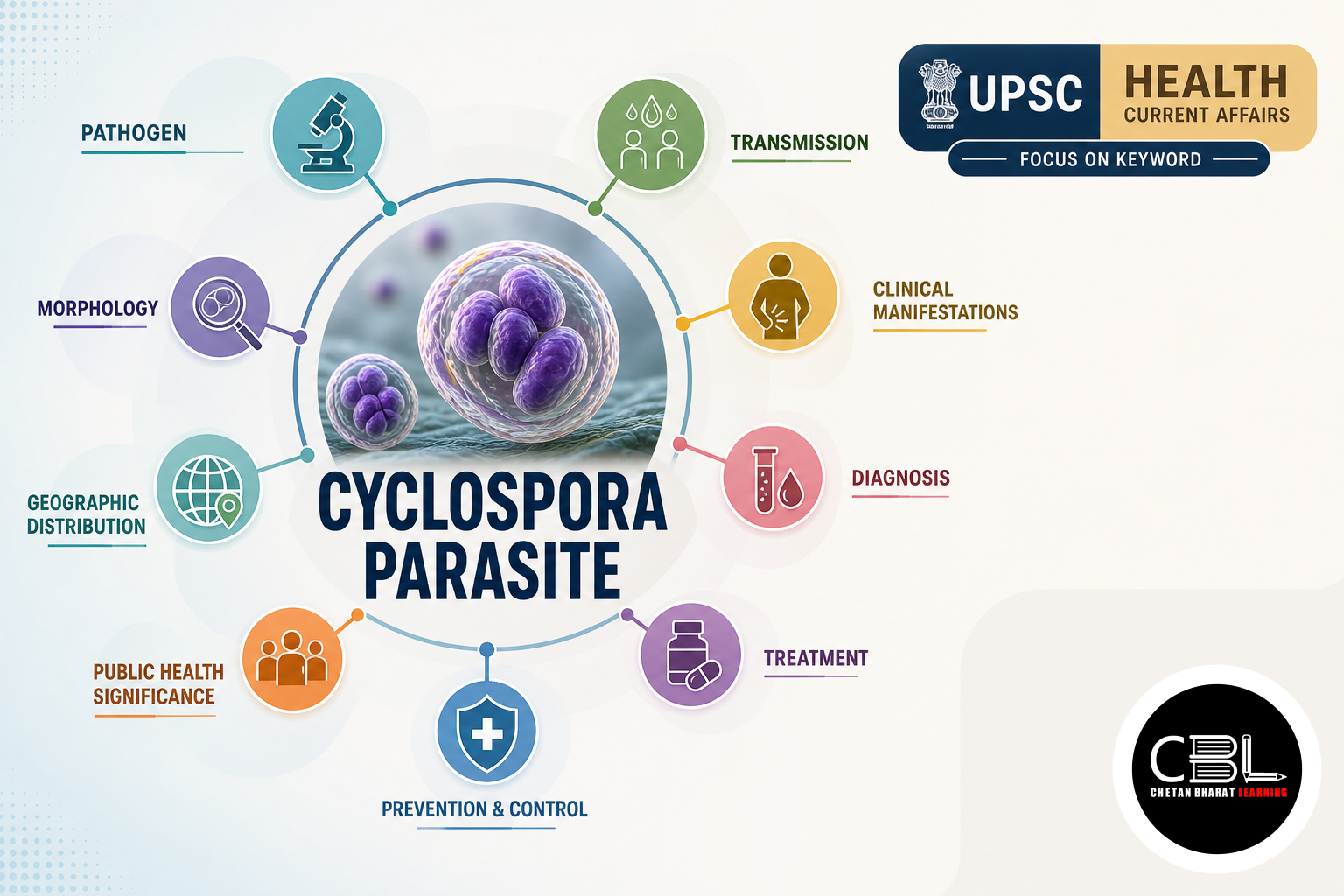
Cyclospora Parasite refers to the protozoan organism Cyclospora cayetanensis, a single-celled microscopic parasite that infects the small intestine and causes cyclosporiasis. Unlike bacteria or viruses, it survives and multiplies within intestinal cells, resulting in prolonged illness. Parasites depend on a host for survival. Human disease-causing parasites are broadly classified into protozoa, helminths and ectoparasites. Cyclospora belongs to the protozoan group and commonly spreads through contaminated food or water.
Why is Cyclospora Parasite in News?
The parasite was linked to one of the largest recorded outbreaks in the United States, with infections traced to contaminated leafy vegetables and fresh produce. Patients experienced prolonged watery diarrhoea, dehydration and fatigue. The outbreak highlighted challenges in food safety because the parasite cannot be cultured like bacteria and requires specialised laboratory techniques for diagnosis.
For official health information, refer to the PIB Official Release.
Key Features of Cyclospora Parasite
| Feature | Description |
|---|---|
| Organism type | Protozoan parasite causing cyclosporiasis |
| Transmission | Contaminated food and water |
| Incubation period | Approximately one week |
| Symptoms | Watery diarrhoea, abdominal cramps, bloating, loss of appetite, weight loss and fatigue |
| Treatment | Co-trimoxazole (routine antibiotics ineffective) |
| Environmental resistance | Oocysts resist chlorine and survive for weeks |
| Person-to-person spread | Uncommon; requires environmental maturation |
Challenges Related to Cyclospora Parasite
- Detection requires specialised laboratory staining and molecular techniques.
- Strong adhesion to leafy vegetables and berries makes washing and chlorination less effective.
- No lasting immunity; reinfection is possible.
- Need for strengthened disease surveillance and food safety systems.
Way Forward for Cyclospora Parasite
- Improved genomic surveillance and rapid laboratory diagnosis.
- Enhanced hygiene throughout the food supply chain and farmer awareness.
- Public education on safe handling of fresh produce.
- International cooperation on food safety standards and detection technologies.
Prelims Practice Corner
| Question | Answer |
|---|---|
| 1. Cyclospora Parasite belongs to which group? | Protozoa |
| 2. The common mode of transmission is: | Contaminated food and water |
| 3. Which symptom is most characteristic of cyclosporiasis? | Watery diarrhoea |
| 4. Cyclospora mainly infects the: | Small intestine |
| 5. Person-to-person spread is generally uncommon because: | Parasite requires environmental maturation |
Mains Practice Questions
- Discuss the public health challenges posed by food-borne parasitic diseases with special reference to Cyclospora Parasite. (Outline: Definition, transmission, diagnosis, food safety, surveillance, policy measures)
- Explain why strengthening food safety systems is important for preventing emerging parasitic diseases. (Outline: Causes, institutional mechanisms, technology, awareness, and international cooperation)
FAQs on Cyclospora Parasite
- What is Cyclospora Parasite? It is a protozoan parasite that causes the intestinal disease cyclosporiasis.
- How does Cyclospora Parasite spread? Primarily through contaminated food and water, especially raw produce.
- Why is Cyclospora Parasite important for UPSC? It connects public health, food safety, microbiology, disease surveillance, and international current affairs, making it relevant for both Prelims and GS-II Mains.
Related Current Affairs
Preparing for UPSC, PCS or HCS?
Talk to a mentor at Chetan Bharat Learning, Chandigarh. Free guidance on choosing the right exam and building a study plan.
Chat on WhatsAppCall 97793 53345UPSC / IAS / PCS coaching in Chandigarh · Trusted by aspirants across Punjab & Haryana
Leave a Reply
You must be logged in to post a comment.