
UPSC Syllabus Mapping
GS Paper: GS-II
Subject: International Relations
Topic: Territorial Disputes, United Nations, UK–Argentina Relations
Prelims: Falkland Islands, UNGA Resolution 2065, South Atlantic Ocean
Mains: Sovereignty disputes, International diplomacy, Peaceful dispute resolution
Overview
The Falkland Islands Dispute returned to global attention after Argentina defeated England in the 2026 FIFA World Cup semi-final, when Argentine players displayed a banner reading “Las Malvinas son Argentinas” (The Malvinas are Argentine). Although the incident occurred on a football field, it revived one of the world’s longest-running territorial disputes between Argentina and the United Kingdom.
Why in News?
- Argentina’s players displayed a political banner supporting Argentina’s claim over the Falkland Islands after their FIFA World Cup semi-final victory against England, bringing the sovereignty dispute back into international focus.
Key Dimensions of the Dispute
Where are the Falkland Islands?
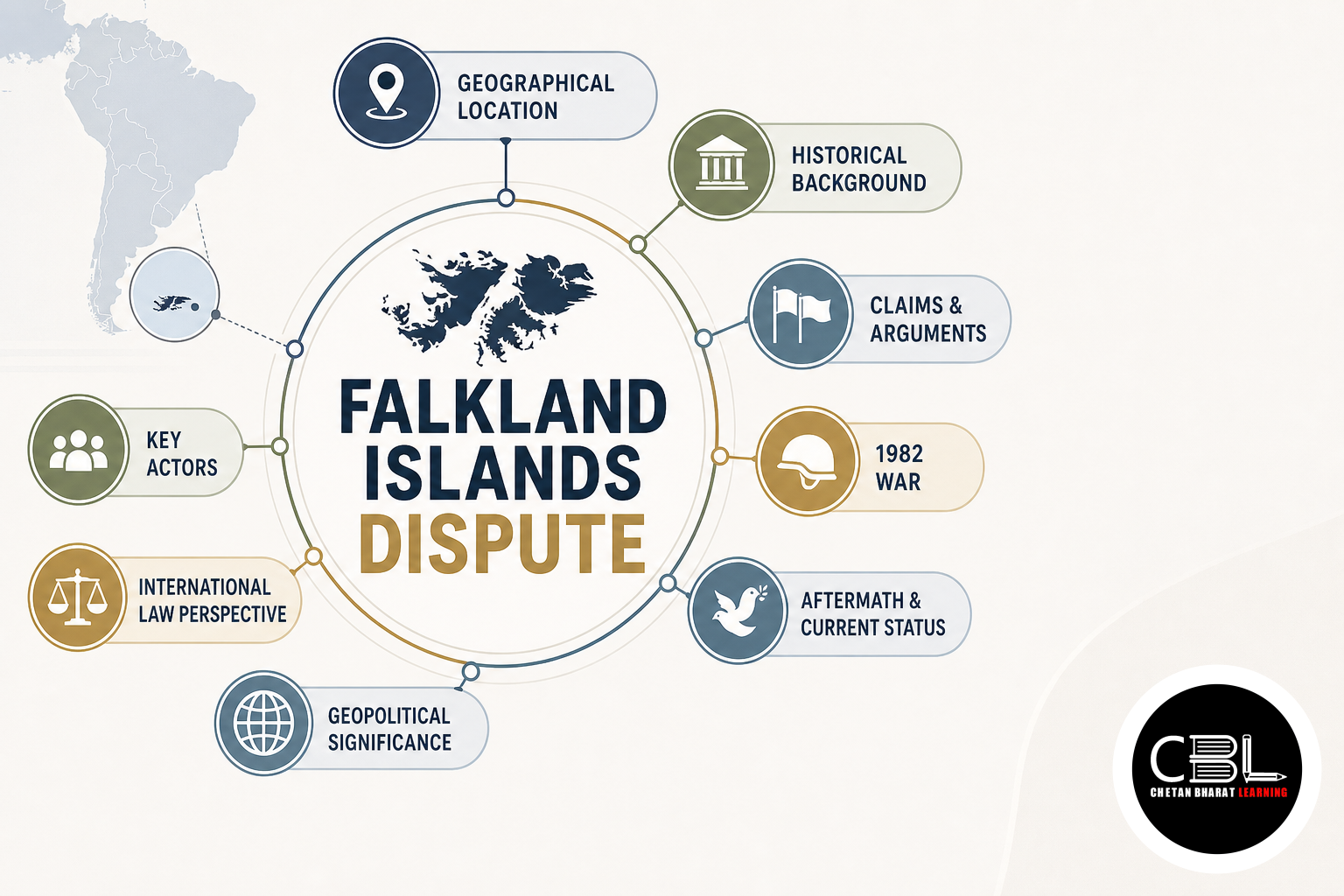
The Falkland Islands, known as Islas Malvinas in Argentina, are an archipelago located in the South Atlantic Ocean, about 500 km east of Argentina’s coast. The islands are currently administered by the United Kingdom as a British Overseas Territory, while Argentina claims sovereignty over them.
Historical Background
- 1764: France established the first settlement.
- 1765: Britain claimed the islands.
- Late 18th century: Spain controlled the islands before withdrawing.
- Post-1816: Argentina claimed sovereignty after its independence.
- 1833: Britain re-established control.
- 1840: Declared a Crown Colony by Britain.
Why are the Islands Important?
- Strategic military location in the South Atlantic.
- Rich fishing resources.
- Potential offshore oil and natural gas reserves.
- Control over surrounding Exclusive Economic Zone (EEZ).
- Geopolitical importance for maritime security.
The 1982 Falklands War
In April 1982, Argentina invaded the Falkland Islands, asserting that Britain had illegally occupied the territory. The United Kingdom launched a military campaign despite the islands being nearly 7,000 nautical miles away. After a 74-day conflict, Britain regained control of the islands. More than 900 people lost their lives during the war.
United Nations Position
In 1965, the UN General Assembly adopted Resolution 2065. The resolution acknowledged the sovereignty dispute and urged both countries to resolve the issue through peaceful negotiations. The resolution is recommendatory and does not determine sovereignty.
Timeline of the Dispute
| Year | Event |
|---|---|
| 1764 | French settlement established |
| 1765 | Britain claimed the islands |
| 1833 | Britain re-established control |
| 1965 | UNGA Resolution 2065 adopted |
| 1982 | Falklands War |
| 2026 | Dispute returned to headlines following FIFA World Cup semi-final |
Importance for UPSC
- Illustrates how historical disputes continue to influence international relations.
- Highlights the role of international law and the United Nations in conflict resolution.
- Demonstrates the strategic significance of maritime territories.
- Useful for understanding sovereignty, decolonisation, and geopolitical conflicts.
Prelims Practice Corner
-
1. The Falkland Islands are located in:
- (a) Indian Ocean
- (b) South Atlantic Ocean
- (c) Pacific Ocean
- (d) Arctic Ocean
Answer: (b)
-
2. The 1982 Falklands War was fought between:
- (a) UK and France
- (b) Argentina and Chile
- (c) Argentina and United Kingdom
- (d) Spain and UK
Answer: (c)
-
3. UN General Assembly Resolution 2065 relates to:
- (a) Climate Change
- (b) Falkland Islands sovereignty dispute
- (c) Antarctic Treaty
- (d) UNCLOS
Answer: (b)
-
4. Argentina refers to the Falkland Islands as:
- (a) Tierra del Fuego
- (b) Islas Malvinas
- (c) Patagonia Islands
- (d) San Martin Islands
Answer: (b)
-
5. Which country currently administers the Falkland Islands?
- (a) Argentina
- (b) Chile
- (c) United Kingdom
- (d) Uruguay
Answer: (c)
Mains Practice Questions
- Q1. Examine the historical and strategic significance of the Falkland Islands dispute between Argentina and the United Kingdom.
Answer Framework: Introduction → Historical evolution → Strategic importance → International law → Way Forward. - Q2. Territorial disputes continue to influence modern diplomacy. Discuss with reference to the Falkland Islands dispute.
Answer Framework: Introduction → Causes → Global implications → Role of the United Nations → Conclusion.
FAQs
- Why are the Falkland Islands disputed?
- Both Argentina and the United Kingdom claim sovereignty based on historical and legal grounds.
- Why are the Falkland Islands strategically important?
- They offer military, maritime, fisheries, and potential energy advantages in the South Atlantic Ocean.
- What was the outcome of the 1982 Falklands War?
- The United Kingdom regained control of the islands after a 74-day conflict, and it continues to administer them.
Related Current Affairs
Preparing for UPSC, PCS or HCS?
Talk to a mentor at Chetan Bharat Learning, Chandigarh. Free guidance on choosing the right exam and building a study plan.
Chat on WhatsAppCall 97793 53345UPSC / IAS / PCS coaching in Chandigarh · Trusted by aspirants across Punjab & Haryana
Leave a Reply
You must be logged in to post a comment.