
Why Climate Change Has Become India’s Biggest Food Security Challenge
In 2026, climate change is no longer just an environmental concern — it has become central to India’s economic stability, agricultural productivity, and national food security strategy. As India moves toward the vision of Viksit Bharat @ 2047, policymakers are increasingly focusing on one major challenge: ensuring that agricultural growth becomes both climate-resilient and low-carbon.
Recent insights from NITI Aayog highlight that India can no longer depend only on increasing food production. The future now lies in “resilient production” — growing crops that can survive:
- Extreme heat
- Erratic rainfall
- Floods
- Water scarcity
while simultaneously reducing greenhouse gas emissions.
The Climate Crisis in Indian Agriculture: Why 2026 Is a Turning Point
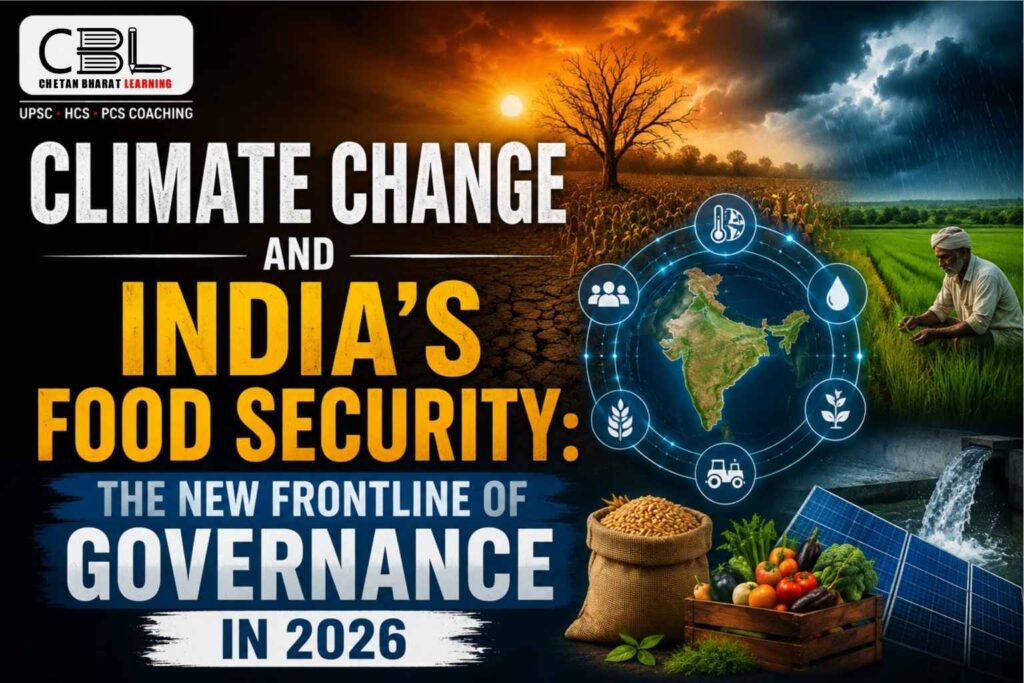
India’s agricultural sector is currently experiencing what experts describe as a “climate squeeze.” According to the State of India’s Environment 2026 report, the country is crossing multiple ecological stress limits, including freshwater depletion and land-system pressure.
1. The Yield Trap: Rising Temperatures and Unpredictable Monsoons
Erratic rainfall, prolonged heatwaves, and changing monsoon patterns are no longer occasional weather disturbances — they are becoming the new normal.
These changes are:
- Reducing wheat and rice productivity
- Increasing pest attacks and crop diseases
- Damaging soil fertility
- Threatening small and marginal farmers
India’s traditional dependence on cereal production is now under significant pressure because climate volatility directly affects crop yields.
2. Food Inflation and Economic Instability
Climate-induced crop failures directly affect food prices and economic stability.
When agricultural output declines:
- Food inflation rises
- Rural incomes fall
- Poor households suffer the most
- Social and economic tensions increase
Daily wage earners and low-income families are especially vulnerable because food expenses constitute a major share of their monthly spending.
3. Agriculture’s Own Carbon Footprint
Ironically, agriculture is not only a victim of climate change — it is also a contributor to greenhouse gas emissions.
Major Agricultural Emission Sources
- Methane emissions from rice cultivation
- Enteric fermentation from livestock
- Excessive use of synthetic fertilizers
- Unsustainable groundwater extraction
India’s challenge in 2026 is therefore two-fold:
- Produce enough food for a growing population
- Reduce agriculture-related emissions simultaneously
India’s Climate-Resilient Agriculture Strategy
The government’s evolving strategy combines:
- Technology
- Financial protection
- Sustainable farming practices
to create a climate-resilient agricultural ecosystem.
Technology-Led Agricultural Transformation
1. Namo Drone Didi Scheme
The Namo Drone Didi Scheme aims to equip 15,000 Women Self-Help Groups (SHGs) with agricultural drones.
Benefits of the Scheme
- Precision spraying of nano-fertilizers
- Reduced chemical wastage
- Lower labor burden on farmers
- Increased efficiency and productivity
- Women-led rural technological empowerment
This initiative also supports sustainable farming by reducing excessive pesticide and fertilizer use.
2. Climate-Resilient Agriculture (CRA) Bill 2025–26
India is developing a legislative framework focused on climate adaptation in agriculture.
Key Features
- District-level climate vulnerability indices
- Automated disaster-response systems
- Aadhaar-linked compensation transfers
- Immediate relief after floods, droughts, or heatwaves
This framework aims to build a faster and more targeted climate safety net for farmers.
Efficient Resource Utilization: The Core of Sustainable Farming
PMKSY – “Per Drop More Crop”
The Pradhan Mantri Krishi Sinchayee Yojana (PMKSY) continues to remain a major pillar of India’s irrigation security strategy.
Objectives
- Promote micro-irrigation systems
- Improve water-use efficiency
- Reduce groundwater depletion
- Support climate-resilient agriculture
With freshwater resources declining rapidly, efficient irrigation is becoming essential for long-term food security.
Integrated Nutrient Management and the “5R Principle”
India is increasingly encouraging balanced fertilizer usage through the 5R Principle:
- Right source
- Right rate
- Right time
- Right place
- Right combination
Why It Matters
- Reduces fertilizer runoff
- Prevents soil degradation
- Improves crop productivity
- Lowers agricultural emissions
This marks a gradual shift away from chemical-intensive farming toward sustainable soil management.
Prelims Focus Points
Major Agricultural Greenhouse Gas Sources
- Enteric fermentation
- Rice cultivation methane emissions
- Synthetic fertilizers
Important National and Global Initiatives
- Lifestyle for Environment (LiFE)
- Kunming-Montreal Global Biodiversity Framework
These initiatives connect biodiversity conservation with climate-resilient agriculture and sustainable resource management.
Financial Safety Nets for Farmers
- Pradhan Mantri Fasal Bima Yojana (PMFBY)
- Pradhan Mantri Kisan Samman Nidhi (PM-KISAN)
These schemes help farmers cope with climate-induced income shocks.
Mains Perspective
Possible Question
“How can India reconcile the goals of ‘Viksit Bharat’ with the need for a net-zero agricultural sector?”
Points to Include in the Answer
- Transition toward agro-ecological farming
- Climate-smart seeds developed by ICAR
- Reduced dependence on chemical fertilizers
- Strengthening Biodiversity Management Committees (BMCs)
- Expansion of micro-irrigation and precision agriculture
- Promotion of renewable energy in farming
Frequently Asked Questions (FAQ)
Why is climate change a major threat to Indian agriculture?
Agriculture depends heavily on stable weather conditions. Rising temperatures, irregular rainfall, floods, and droughts reduce crop productivity and increase farmer distress.
What does “climate-resilient agriculture” mean?
Climate-resilient agriculture refers to farming systems that can withstand extreme weather conditions while maintaining productivity and protecting natural resources.
How is the government helping farmers adapt?
The government is supporting farmers through:
- Crop insurance
- Income support
- Precision farming technologies
- Better irrigation systems
- Climate-sensitive policy interventions
Why is sustainable farming important for India’s future?
Unsustainable farming degrades soil, wastes water, and increases emissions. Sustainable agriculture ensures long-term food security while protecting environmental resources for future generations.
Conclusion: India’s Agricultural Future Depends on Climate Resilience
India’s food security challenge is no longer just about producing more food grain — it is about producing food sustainably in an era of climate uncertainty.
The future of Indian agriculture will depend on:
- Climate-smart technologies
- Water-efficient farming
- Soil conservation
- Farmer-centered financial protection
- Low-carbon agricultural practices
As India moves toward becoming a developed economy, climate resilience will determine the long-term strength of its agricultural sector and food sovereignty.
“Climate resilience is no longer optional — it is the primary prerequisite for India’s food sovereignty in the 21st century.”
“A bad environment can never be good economics. India’s agricultural future depends on treating soil as a living and fragile asset, not an infinite resource.”
Leave a Reply
You must be logged in to post a comment.