
Imagine a world where a farmer in a remote village in Odisha can access credit, receive government subsidies, and sell his produce to a buyer in Delhi — all within a few clicks on a smartphone. This isn’t a futuristic vision; it is the reality of India’s Digital Public Infrastructure (DPI).
As India accelerates toward its ambitious $25 trillion economy target by 2047, the “India Stack” has evolved from an experimental project into the foundation of modern digital governance and statecraft.
But how did a country with massive socio-economic diversity build one of the world’s most advanced digital ecosystems? More importantly, can this “public good” model remain scalable and secure in an era of rising cyber security threats and digital vulnerabilities?
The Foundation: The JAM Trinity and Beyond
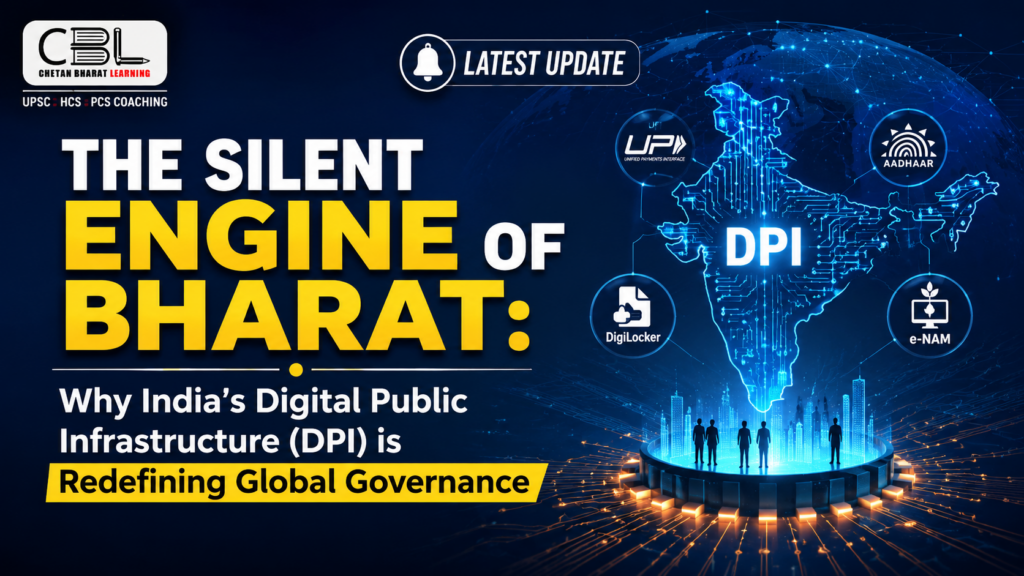
The DPI ecosystem is built on the JAM Trinity — Jan Dhan, Aadhaar, and Mobile connectivity. Together, these three pillars created the basic digital rails for financial inclusion, governance, and welfare delivery.
As of March 2026, the scale of India’s digital transformation is extraordinary.
Aadhaar
India’s Aadhaar ecosystem has crossed:
👉 1.44 billion enrolments
This provides citizens with a verifiable digital identity, making services:
✔ Portable
✔ Accessible
✔ Efficient
A citizen can now digitally authenticate identity from almost anywhere in the country.
Financial Inclusion
The Pradhan Mantri Jan Dhan Yojana (PMJDY) has dramatically expanded banking access.
Bank accounts increased from:
- 14.72 crore in 2015
to - 57.71 crore by March 2026
This has significantly improved financial inclusion across rural and semi-urban India.
Connectivity
India’s digital infrastructure has also expanded rapidly.
Current scale:
- 125.87 crore wireless subscribers
- 5G connectivity in 99.9% of districts
This has brought India closer to solving the “last-mile connectivity” challenge.
Beyond these foundational pillars, DPI 2.0 has now emerged, integrating governance and services across multiple sectors.
ONDC
The Open Network for Digital Commerce (ONDC) is a protocol-based digital network designed to democratize e-commerce.
Unlike traditional private platforms, ONDC allows:
✔ Small sellers
✔ Local businesses
✔ MSMEs
to participate more freely in digital commerce ecosystems.
This reduces excessive dependence on dominant e-commerce giants.
ABHA
Under the Ayushman Bharat Digital Mission, India launched the ABHA digital health ecosystem.
Its objective is to create:
- Interoperable health records
- Digital health identity systems
- Better healthcare coordination
This improves continuity and accessibility in healthcare delivery.
PFMS
The Public Financial Management System (PFMS) has become one of the strongest pillars of welfare governance.
Through Direct Benefit Transfers (DBT), the system has routed:
➤ More than ₹49 lakh crore
At the same time, leakages worth:
➤ ₹4.31 lakh crore+
have reportedly been prevented.
This demonstrates how digital governance can improve fiscal efficiency and reduce corruption.
The Challenges: Risks of a Connected Nation
Despite its success, India’s DPI model also faces serious structural and security challenges.
Chief Economic Advisor V. Anantha Nageswaran has repeatedly emphasized an important point:
Digital infrastructure does not automatically guarantee digital inclusion.
The Digital Divide
Although internet connectivity has expanded rapidly, digital literacy remains uneven.
Challenges still persist among:
- Elderly populations
- Rural communities
- Connectivity-deprived regions
Having access to smartphones does not necessarily mean citizens can effectively use:
- Digital payments
- E-governance services
- Online healthcare
- Digital financial systems
Cyber-Fragility
As India builds one of the world’s largest repositories of citizen data, cybersecurity risks are also increasing.
India’s digital infrastructure may become vulnerable to:
- State-sponsored cyber attacks
- Data breaches
- Financial fraud
- Critical infrastructure disruption
The larger the digital ecosystem becomes, the more essential cyber resilience becomes.
State-Level Variation
While India’s central digital infrastructure is globally admired, the actual citizen experience often varies across states and municipalities.
Many local governance systems still struggle with:
- Weak digital integration
- Poor infrastructure
- Administrative delays
As a result, implementation quality remains uneven across regions.
Prelims Pointers
UPI
In January 2026 alone:
- UPI processed 21.7 billion transactions
- Transaction value crossed ₹28.33 lakh crore
This reflects the extraordinary scale of India’s digital payment ecosystem.
International Reach
India has signed DPI cooperation agreements with:
➤ 23 countries
UPI services are now operational in:
- France
- Singapore
- UAE
- Mauritius
India’s digital governance architecture is gradually gaining global relevance.
ONDC
An important point to remember:
➤ ONDC is not an app.
It is a digital network based on interoperable protocols that allow multiple platforms to communicate seamlessly.
Mains Analysis
Question
“Digital Public Infrastructure is a double-edged sword for India.” Critically examine.
Focus Areas:
- Inclusion vs exclusion
- Data security concerns
- Digital sovereignty
- Cyber resilience
- Need for a strong Digital Personal Data Protection framework
FAQ Bank
DPI is a “Digital Road”
Digital Public Infrastructure can be understood as public digital roads.
Just as physical roads allow vehicles to move, DPI creates digital infrastructure that allows:
- Startups
- Fintech platforms
- Service providers
to build innovative services on top of common digital rails.
Open Architecture
India’s DPI model uses:
➤ Open APIs
This allows private innovation while the government maintains control over the foundational infrastructure.
Financial Resilience
UPI and Jan Dhan have helped formalize large sections of the informal economy.
This reduces dependence on:
- Cash-based systems
- Informal lending
- Predatory credit networks
Interoperability
One of DPI’s biggest strengths is interoperability.
Because systems can communicate with one another:
✔ Repeated verification becomes unnecessary
✔ Service delivery becomes faster
✔ Governance efficiency improves
The Goal
India’s larger objective is to move citizens:
- From simple digital access
to - Meaningful digital participation
This means using digital infrastructure not only for payments, but also for:
- Credit access
- Healthcare
- Commerce
- Governance participation
Final Takeaway
India’s Digital Public Infrastructure is not merely a technological innovation.
It represents a new model of state-citizen interaction at population scale.
By proving that population-scale digital problems can be solved through Public Digital Goods rather than depending entirely on private platforms, India has presented a governance blueprint for the 21st century.
The long-term success of this model, however, will depend on balancing:
✔ Inclusion
✔ Innovation
✔ Privacy
✔ Cybersecurity
✔ Digital trust
in an increasingly interconnected world.
Leave a Reply
You must be logged in to post a comment.