
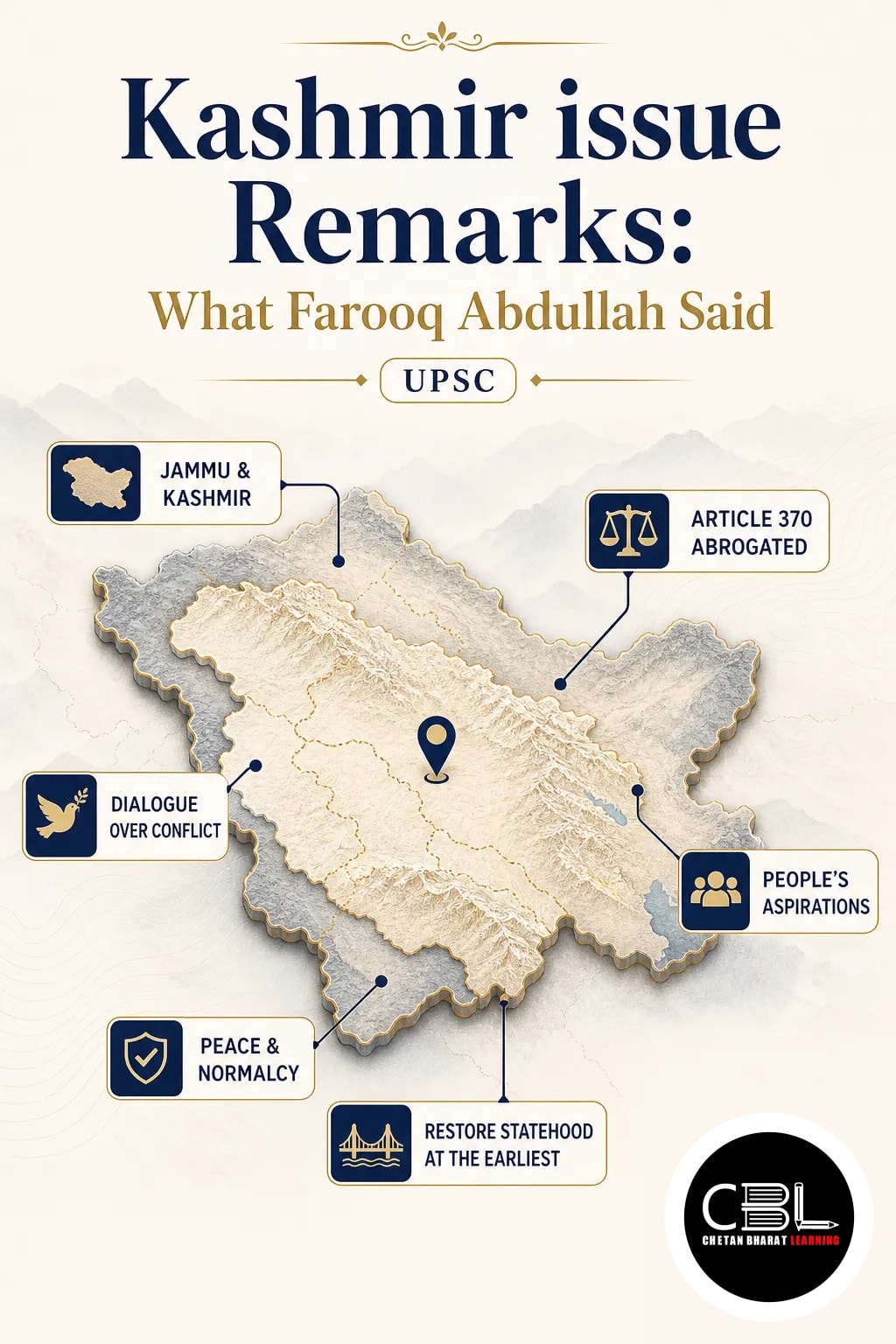

Farooq Abdullah’s Kashmir issue remark has renewed attention on the long-running India-Pakistan dispute, and its political resonance can be tracked through CBL current affairs coverage. The reported comment that Pakistan was keeping the issue alive has triggered a fresh political row.
What is Kashmir Issue?
The Kashmir issue refers to the disputed political and territorial question surrounding Jammu and Kashmir since Partition. It remains shaped by India-Pakistan rivalry, cross-border tensions, and the constitutional status of the region.
In Indian polity, the subject also involves federal arrangements, security concerns, and the Centre’s responsibility in a sensitive border region. Public statements on it often acquire importance because they affect domestic politics and bilateral perceptions.
Why in News?
The issue returned to headlines after Farooq Abdullah reportedly said that Pakistan was keeping the Kashmir issue alive. The remark drew political reactions and reopened debate on how leaders frame the dispute.
Such comments matter because Kashmir remains both a governance question and a national security subject. They also show how a single political statement can revive an old and unresolved policy debate.
Key Features
- Disputed legacy – The Kashmir question arose from the events of Partition and subsequent conflict, making it one of South Asia’s most enduring disputes.
- Security dimension – The region carries strategic importance because of its borders, internal security concerns, and external policy implications.
- Constitutional angle – Its political handling has involved constitutional provisions, Centre-state relations, and administrative restructuring.
- Diplomatic sensitivity – Any public remark on Kashmir often affects India-Pakistan discourse and domestic political narratives.
Challenges
- Persistent bilateral tension – The issue remains linked to mistrust between India and Pakistan, limiting trust-building efforts.
- Political polarisation – Statements on Kashmir can quickly turn into partisan controversy, reducing space for calm discussion.
- Security and development balance – Policymakers must address security concerns while promoting normal governance and economic progress.
- Public narrative wars – Competing claims and counterclaims keep the issue alive in media and political debate.
Way Forward
A durable response needs constitutional clarity, political restraint, and consistent governance. Leaders can reduce noise by focusing on development, democratic participation, and security without inflammatory language.
For India, the broader approach should combine internal stability with a firm diplomatic position. That balance matters because the Kashmir issue is both a domestic governance matter and an external affairs concern.
Source: Indian Express India, 2026-10-24
This topic is useful for state PCS General Studies under polity, internal security, and current affairs. It helps candidates connect Jammu and Kashmir developments with Centre-state relations, federalism, and the wider India-Pakistan security environment.
FAQ
Why do Kashmir remarks become controversial?
Because they touch on a dispute linked to history, security, and foreign policy. Public comments can be read as political signalling, which increases scrutiny.
Why is Kashmir important for UPSC?
It connects to polity, internal security, and international relations. The topic also helps in answering questions on federalism and constitutional governance.
How should aspirants study this topic?
Focus on the constitutional framework, the historical background, and the India-Pakistan dimension. Also track how current political statements shape public debate.
Related Current Affairs
Preparing for UPSC, PCS or HCS?
Talk to a mentor at Chetan Bharat Learning, Chandigarh. Free guidance on choosing the right exam and building a study plan.
Chat on WhatsAppCall 97793 53345UPSC / IAS / PCS coaching in Chandigarh · Trusted by aspirants across Punjab & Haryana
Leave a Reply
You must be logged in to post a comment.