
Important for:
UPSC, Haryana HCS, Punjab PCS
Prelims: National Security Act (NSA), Habeas Corpus, Preventive detention
Mains: GS Paper 2 — Polity, Fundamental Rights, Judiciary
Why in News?
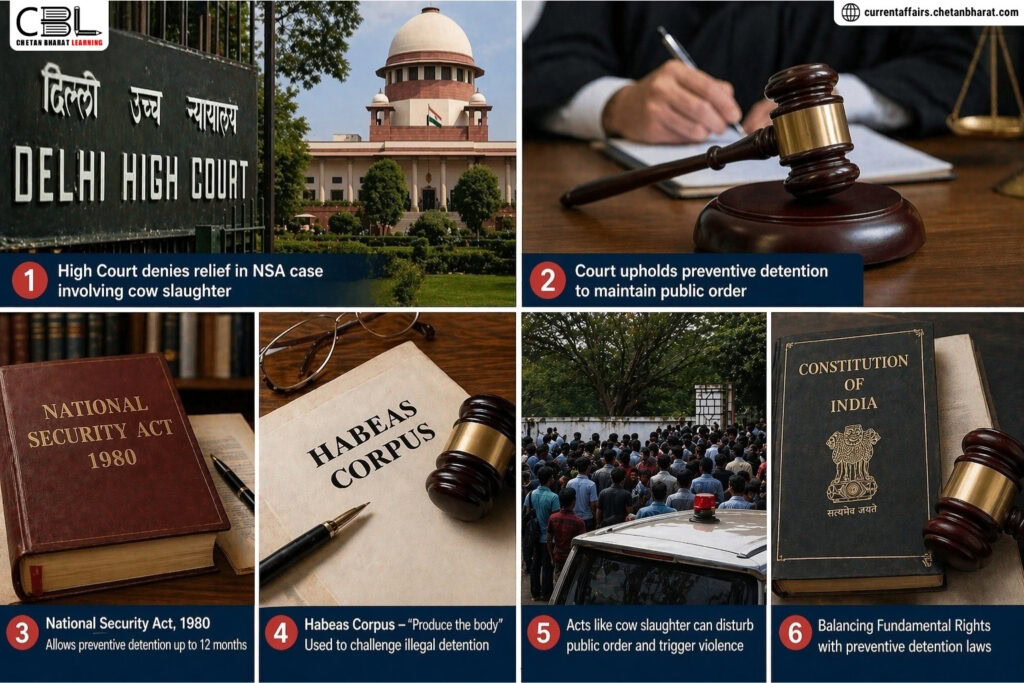
A High Court dismissed a habeas corpus petition filed by a person detained under the National Security Act (NSA) in a case linked to cow slaughter, stating that such acts can provoke violent public reactions and disturb public order.
What is Preventive Detention?
Preventive detention refers to:
👉 Detaining a person without trial
👉 To prevent potential threats to:
- National security
- Public order
Constitutional basis:
- Article 22 (3–7) of the Indian Constitution
What is the National Security Act (NSA), 1980?
- Allows preventive detention up to 12 months
- Can be invoked by:
- Central Government
- State Governments
- District Magistrates
👉 Grounds:
- Threat to national security
- Disturbance of public order
- Disruption of essential services
What is Habeas Corpus?
- A writ petition under Article 32 / 226
- Meaning: “produce the body”
- Used to:
👉 Challenge illegal detention
Court’s Observation
- Cow slaughter can trigger violent public reactions
- Therefore, Such acts may disturb public order
👉 This shows judicial support for:
State action in maintaining public order
Key Constitutional Tension
| Fundamental Right | State Power |
| Article 21 (Right to Life & Liberty) | Preventive detention laws |
| Judicial review | Executive authority |
| Due process | Pre-emptive detention |
Critical Analysis
Arguments in Favour:
- Firstly, it helps prevent riots and violence
- Additionally, it maintains law and order
- Allows proactive governance
Arguments Against:
- “However, critics argue that preventive detention laws can weaken civil liberties.”
India-Specific Context
- Preventive detention laws widely used in:
- Law & order situations
- Political contexts (sometimes controversial)
- Courts generally:
👉 Balance individual liberty vs public order
Quick Recap for Exam
- What: High Court dismissed habeas corpus plea in NSA detention case
- Law involved: National Security Act (NSA), 1980
- Key issue: Preventive detention vs personal liberty
- Court stance: Detention justified due to potential threat to public order
- Core debate: Security vs Fundamental Rights
PRELIMS PRACTICE QUESTIONS
Q1. Which of the following Articles deal with preventive detention?
- Article 21
- Article 22
- Article 19
A. 2 only
B. 1 and 2 only
C. 2 and 3 only
D. 1, 2 and 3
✅ Answer: A
Q2. Which of the following is correct about Habeas Corpus?
- It is a writ to enforce Fundamental Rights
- It can be issued against both public and private authorities
- It is available even during Emergency
A. 1 only
B. 1 and 2 only
C. 1, 2 and 3
D. 2 and 3 only
✅ Answer: C
Q3. Under NSA, maximum detention period is:
A. 3 months
B. 6 months
C. 12 months
D. Indefinite
✅ Answer: C
Q4. Which authority can invoke NSA?
- District Magistrate
- State Government
- Parliament only
A. 1 and 2 only
B. 2 and 3 only
C. 1 only
D. 1, 2 and 3
✅ Answer: A
Q5. Preventive detention is allowed under which part of Constitution?
A. DPSP
B. Fundamental Duties
C. Fundamental Rights
D. Emergency provisions
✅ Answer: C (with restrictions under Article 22)
Q6. Which writ is used to challenge unlawful detention?
A. Mandamus
B. Certiorari
C. Habeas Corpus
D. Prohibition
✅ Answer: C
Q7. Which of the following statements is incorrect?
A. Preventive detention requires a trial
B. NSA allows detention without formal charges
C. Habeas Corpus protects personal liberty
D. Courts can review detention
✅ Answer: A
CBL Mains Practice Question
“Preventive detention laws represent a necessary evil in a democratic setup.”
Critically examine in the context of recent judicial trends.
FAQs
1. What is the National Security Act (NSA)?
The NSA is a preventive detention law that allows detention without trial.
2. What is Habeas Corpus?
A legal remedy to challenge unlawful detention and secure release.
3. Why are preventive detention laws controversial?
They restrict personal liberty and can be misused.
4. Which GS paper covers this topic?
GS Paper 2 — Polity, Constitution, Judiciary.
5. Can courts interfere in preventive detention?
Yes, through judicial review, especially via habeas corpus petitions.
Related Current Affairs
Preparing for UPSC, PCS or HCS?
Talk to a mentor at Chetan Bharat Learning, Chandigarh. Free guidance on choosing the right exam and building a study plan.
Chat on WhatsAppCall 97793 53345UPSC / IAS / PCS coaching in Chandigarh · Trusted by aspirants across Punjab & Haryana
Leave a Reply
You must be logged in to post a comment.