
Important for:
UPSC, Haryana HCS, Punjab PCS
Prelims: National Board for Wildlife, CAMPA, pastoralism, transhumance
Mains: GS Paper 3 — Environment, Biodiversity, Conservation vs Livelihoods
Why in News?
The Standing Committee of the National Board for Wildlife (SC-NBWL) has directed the Wildlife Institute of India (WII) to conduct a comprehensive study on the dependence of pastoral and nomadic communities on forests within national parks and sanctuaries.
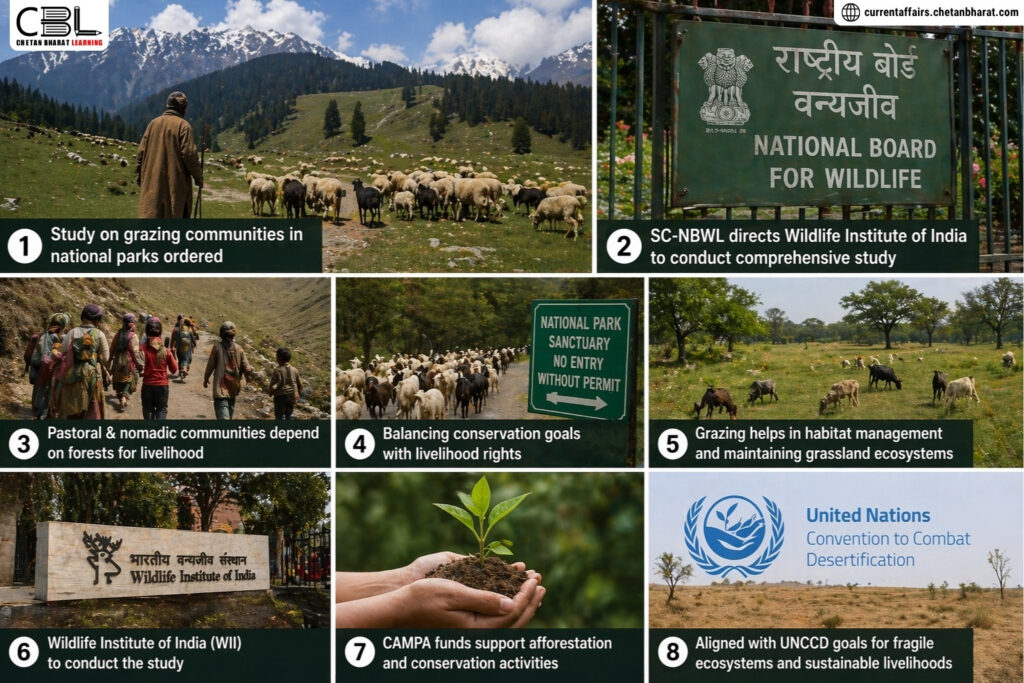
Who are Pastoralist Communities?
Pastoralists are communities that depend on livestock rearing and seasonal migration (transhumance) for livelihood.
Prominent examples in India include:
- Gujjars
- Bakkarwals
- Gaddis
- Raikas
- Dhangars
- Maldharis
- Changpas
These communities depend on:
- Grasslands
- Forest areas
- Scrublands and plateaus
Key Issue: Grazing vs Conservation
Pastoralists often migrate seasonally across:
- State boundaries
- Forest areas
- Protected regions (national parks & sanctuaries)
This creates a policy conflict:
| Conservation Goals | Livelihood Needs |
| Protect wildlife habitats | Access to grazing land |
| Restrict human activity | Sustain traditional livelihoods |
| Prevent overgrazing | Maintain pastoral economy |
What Did the Panel Highlight?
- Pastoral communities face difficulties accessing grazing rights inside protected areas
- A balanced approach is needed between:
- Conservation
- Livelihood rights
Grazing can actually contribute to:
- Habitat management
- Maintaining grassland ecosystems
Key Institutions Mentioned
- National Board for Wildlife (NBWL)
→ Apex body for wildlife conservation in India - Wildlife Institute of India (WII)
→ Research and advisory body on wildlife - CAMPA (Compensatory Afforestation Fund Management and Planning Authority)
→ Funds afforestation and conservation activities
International Context
The issue aligns with concerns raised under the
United Nations Convention to Combat Desertification (UNCCD)
👉 Especially in fragile ecosystems like:
- Himalayas
- Arid and semi-arid regions
India-Specific Dimension
- India has a large pastoral population
- Many communities are historically dependent on forests
- Policy challenge:
- Integrating traditional ecological knowledge
- With modern conservation frameworks
Quick Recap for Exam
What: Study ordered on pastoral communities’ dependence on forests inside protected areas
Who: Standing Committee of National Board for Wildlife (SC-NBWL)
Conducted by: Wildlife Institute of India (WII)
Why: Conflict between conservation goals and grazing rights
Key angle: Balancing biodiversity protection with traditional livelihoods
CBL Prelims Practice Question
Consider the following statements:
- The National Board for Wildlife is chaired by the Prime Minister
- CAMPA funds are used for wildlife conservation and afforestation
- Pastoralists primarily depend on industrial agriculture
Which of the statements given above is/are correct?
A. 1 and 2 only
B. 2 and 3 only
C. 1 only
D. 1, 2 and 3
✅ Answer: A
CBL Mains Practice Question
“Conservation policies in India often come into conflict with traditional livelihood practices.”
Critically examine this statement in the context of pastoral communities and protected areas. (250 words)
FAQs
1. Why is grazing in protected areas controversial?
Because it creates conflict between biodiversity conservation and livelihood rights of pastoral communities.
2. What is transhumance?
It is the seasonal migration of pastoral communities along with their livestock.
3. Which body regulates wildlife conservation in India?
The National Board for Wildlife (NBWL) is the apex advisory body.
4. How does grazing help ecosystems?
Controlled grazing can maintain grasslands and prevent ecological imbalance.
Related Current Affairs
Preparing for UPSC, PCS or HCS?
Talk to a mentor at Chetan Bharat Learning, Chandigarh. Free guidance on choosing the right exam and building a study plan.
Chat on WhatsAppCall 97793 53345UPSC / IAS / PCS coaching in Chandigarh · Trusted by aspirants across Punjab & Haryana
Leave a Reply
You must be logged in to post a comment.